Two Rooms, One Tuesday
It is a Tuesday in late winter, 2026. Beijing is overcast. San Francisco is bright. A man named Yi Zeng is sitting at a desk on the campus of the Institute of Automation at the Chinese Academy of Sciences, scrolling through a specification for a module of his BrainCog platform. The module is called, in its English translation, theory of mind. The technical content is a set of equations describing how a spiking neural network should represent the mental states of other agents — what they want, what they believe, what they intend, what they might do next. The architectural inspiration comes from mirror neuron systems in primate brains. The philosophical inspiration comes from a passage in Mencius about a child falling toward a well.
In that passage, Mencius argues that any human being who saw the child about to fall would feel alarm and compassion immediately — not because the child belonged to them, not because they expected reward, not because they feared social consequences, but because the capacity to feel the suffering of another as one's own is native to the human heart. Mencius calls this capacity ren — usually translated as benevolence or humaneness. The Confucian tradition for two and a half millennia has called ren the root virtue, the one from which the other virtues grow. The challenge of moral cultivation, in the tradition Yi Zeng has inherited, is not to install ren from outside. It is to develop what is already there.
Yi Zeng's claim is that benevolence in this sense is an engineering constraint for AI systems, not an ethical garnish to be sprinkled on after deployment. You cannot build a system capable of harming people at scale, deploy it, and then retrofit care. The harm is already done. The architecture that permitted the harm is in place. What you get by retrofitting is a system that can discuss benevolence, not a system that has it. So benevolence must be in the architecture. The spiking dynamics must encode the capacity to model other agents as having states that matter. The decision-making must include something like the immediate alarm Mencius described. The module Yi Zeng is staring at on this Tuesday afternoon in Beijing is an attempt — a partial, imperfect, technically modest, philosophically ambitious attempt — to begin to do that.
On the same Tuesday, six time zones west, a man named Dario Amodei is preparing to testify before a Senate committee. He is the CEO of Anthropic, the AI lab he co-founded after leaving OpenAI in 2021. The hearing is about capability thresholds and safety obligations. Amodei is going to do something he has been doing in public for several years: he is going to refuse, throughout his testimony, to use the term "AGI."
The word, in his account, has a problem. Decades of philosophical debate have produced no operational definition. Nobody can specify, in advance, what observation would distinguish the presence of an artificial general intelligence from its absence. The term invites the wrong kind of conversation — abstract, contested, infinitely deferrable. Amodei replaces it with "powerful AI" and defines that phrase by capability thresholds you can in principle measure. A system smarter than a Nobel laureate across most relevant fields. Running as millions of instances at ten to a hundred times human speed. Capable of autonomously completing tasks that take human teams a week or more.
This is not a marketing maneuver. It is a political act dressed as a technical clarification. Amodei is a former biophysicist. In biophysics, you do not debate whether a particle exists. You specify what observation would distinguish its existence from its absence, and you build the instrument that produces that observation. The methodology imports wholesale. The Responsible Scaling Policy that Anthropic publishes — the framework of AI Safety Levels (ASL-1 through ASL-4 and onward) that ties capability thresholds to specific safety measures the company commits to in advance — is the procedural extension of the same habit. You measure the capability. You commit, before the capability arrives, to the conditions under which deployment is and is not permissible. You publish the commitment so that the institution's future self is constrained by its past self under conditions outsiders can verify.
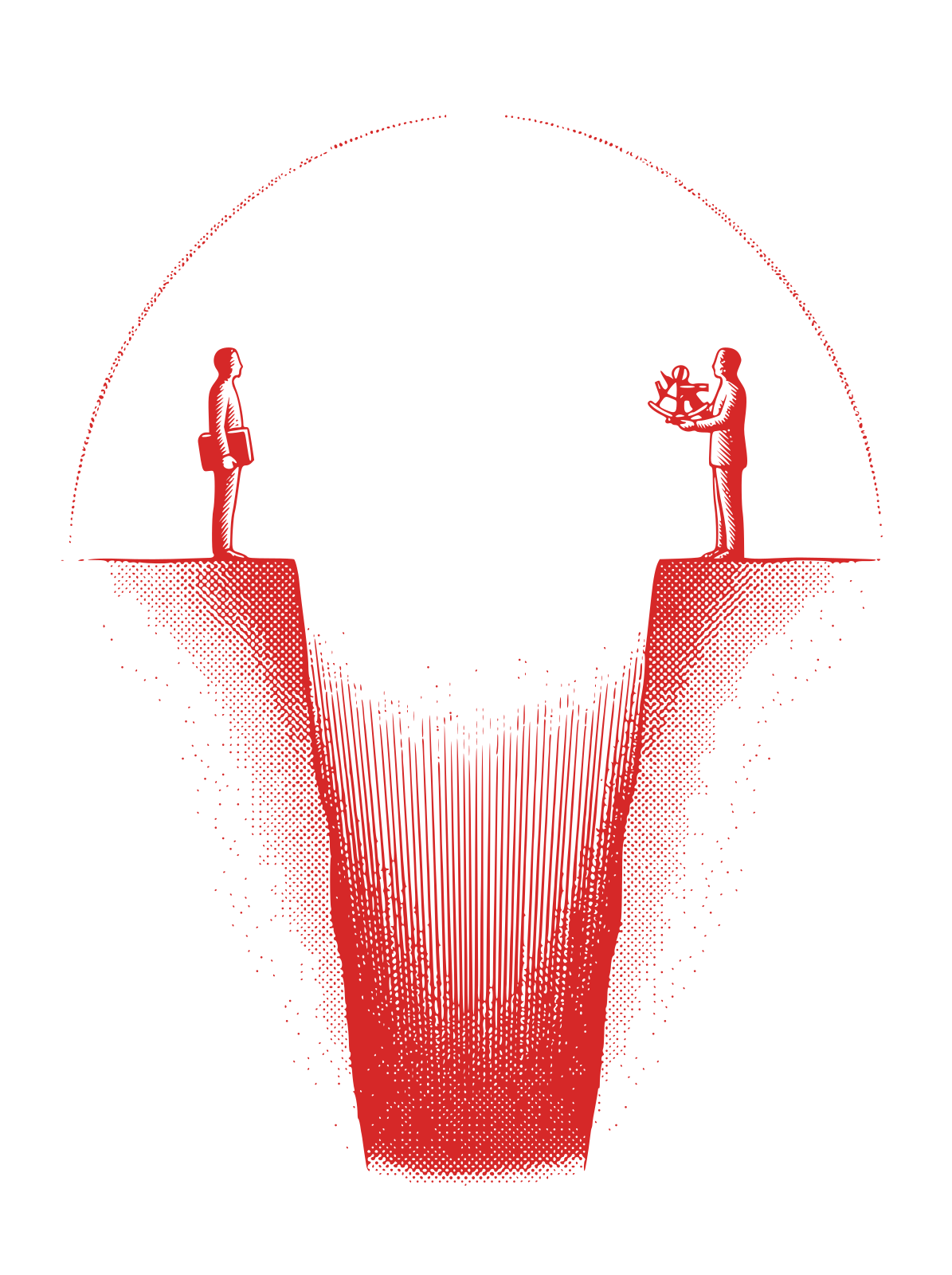
That is the testimony Amodei will give on Tuesday. The room he is preparing to walk into is in the Russell Senate Office Building. The room Yi Zeng is sitting in is in northeastern Beijing. Both rooms contain a person trying to do the same job: build a vocabulary the technology can hear.
They do not know they are doing the same job. The vocabularies they are building do not share roots. Yi Zeng's vocabulary is two thousand five hundred years old — ren, he (harmony as the dynamic equilibrium of genuinely different elements), zhi (intelligence) carefully distinguished from zhihui (wisdom). Amodei's vocabulary is fifteen years old, in the strict sense — most of the relevant terms (scaling laws, mechanistic interpretability, capability thresholds, ASL classifications, responsible scaling) were invented in the 2010s and 2020s, in a small number of California and Massachusetts research labs, by people who had read the Western philosophical canon if they had time and the technical literature whether they had time or not. The two vocabularies do not translate cleanly. The terms refer to different conceptual objects, embedded in different ontologies, deployed for different purposes, evaluated against different criteria.
And yet the underlying machine — the transformer, the gradient descent algorithm, the GPU cluster, the inference endpoint — is the same machine. The training compute is the same compute. The scaling law is the same scaling law. The two rooms are wrestling with the same physical artifact, in the same calendar week, with vocabularies that cannot quite see each other across the room.
[YOU] on AI introduced the figure of the fishbowl. The water you breathe. The glass that shapes what you see. Every fishbowl reveals part of the world and hides the rest. The best thinking, the book argued, is the attempt to press your face against the glass and see, even for a moment, the world beyond the water you have always breathed.
That book asked the question at human scale. It asked what it means to live inside a fishbowl as an individual confronting a transformative technology. This book asks the question one scale up. What does it mean for a civilization to live inside a fishbowl? What does it mean for two great civilizations, each inside its own fishbowl, to be racing toward the same December 2025 capability threshold from inside assumptions so deeply embedded that neither civilization can see them from inside, and neither can see the other clearly from outside?

This is not a story about who is winning the race. The race framing is itself an artifact of one fishbowl. From the Confucian River — the river Yi Zeng and Bing Song and Zheng Yongnian and Kai-Fu Lee and Robin Li are swimming in — the question is not who wins. The question is what kind of civilization is being constituted through what kind of technology, and whether the relational fabric on which civilization depends is being deepened or eroded in the process. The race framing imports an answer to the prior question — that competition between sovereign individuals or sovereign nations is the structure of reality — that the Confucian tradition does not necessarily share. From the Promethean River — the river Amodei and Musk and Altman and Zuckerberg and Huang are swimming in — the race framing makes intuitive sense, because the autonomous capability-bearing entity (the individual, the lab, the company, the nation, the model itself) is the unit of analysis, and capability advancement is the variable. Of course there is a race. There is always a race. The only question is who wins.
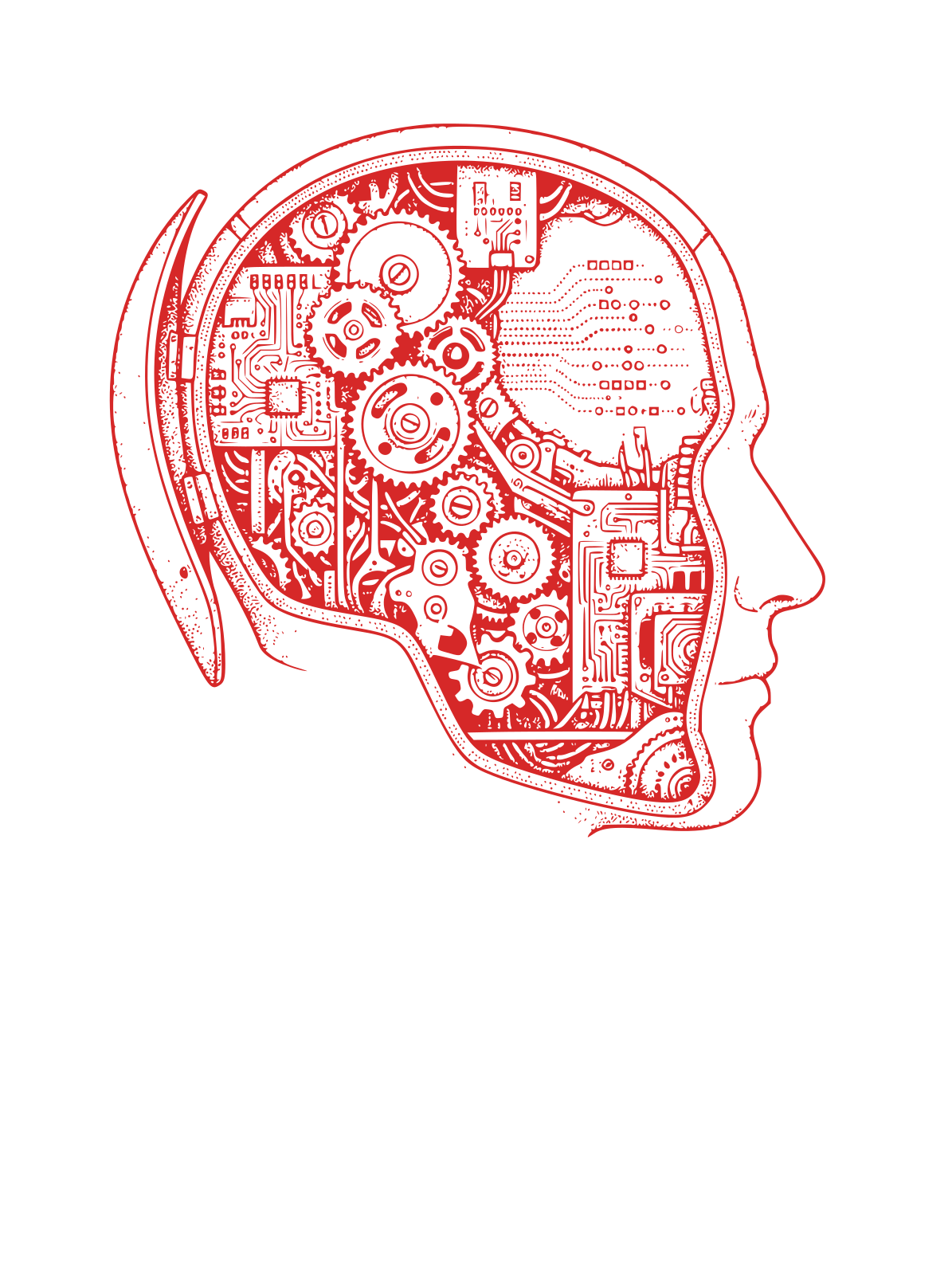
Both fishbowls are coherent. Both are serious. Neither is universal. That is the recognition this book is trying to produce.
The two rooms on Tuesday are not a coincidence. They are the book's thesis in miniature. Yi Zeng in Beijing trying to write benevolence into a spiking network because the wisdom gap is the central engineering problem. Amodei in Washington refusing to say "AGI" because the philosophical word cannot be operationalized fast enough to govern. Same week. Same technology. Different questions. Different conversations. Two fishbowls that have not yet learned to see each other from outside.
This book is the attempt to see them both. To hand the reader the orange pill twice — one pill for each bowl — and to walk together to the bridge between them, where the view is binocular and the work begins.
The water is moving. The rooms are filling. The questions are coming due.
Take the stairs.