The Garden and the Network
We have walked five Chinese voices in their own registers. We are standing now inside the Confucian River. Before we step back to the bank and dry off for the walk across to the Promethean side, this chapter is a pause. What does it feel like to take the orange pill inside a fishbowl whose water is 2,500 years old?
Begin with the texture. The water in the Confucian fishbowl is older than almost any other water still being drunk by any contemporary civilization. The tradition has had time. It has cycled through dynasties and breakdowns and reforms and Cultural Revolutions and now contemporary reconstructions. It has been tested against agricultural collapse, foreign invasion, internal civil war, modernization, ideological transformation, and the arrival of the most transformative technology in human history. The tradition is not pristine. It is bruised, scarred, partially forgotten, partially recovered, currently being re-articulated by people working at the intersection of the classical inheritance and the contemporary technical environment. But it is still drinkable. The water has not gone bad.
What the water tastes like, when you drink it deliberately rather than reflexively, is relational. The bedrock assumption is that the bounded autonomous individual is a useful abstraction for some purposes and an inaccurate ontology for most others. The person you are is constituted, at every level, by the relationships you inhabit. Your parents. Your siblings. Your spouse. Your children. Your colleagues. Your teachers. Your students. The community that raised you. The tradition that taught you what counts as a question. The cosmos in which all of these participate. You are not a node added to the network. You are a node produced by it. Subtract the network and what remains is not a deeper self. It is no self at all.
This taste, once you have absorbed it, is not exotic. It is, in fact, recognizable. Every parent who has loved a child knows, at the level the metabolic vocabulary cannot quite reach, that the relationship constitutes the participant. Every long marriage knows it. Every deep friendship knows it. Every craft tradition that requires a master to make an apprentice into a master knows it. The Confucian tradition is unusual not because it has invented the relational truth but because it has articulated the relational truth at the level of explicit ontology and has built a civilization's worth of philosophical, political, and ritual practice around the articulation.
The Western tradition has the relational truth too. It is just buried under several layers of post-Cartesian individualism that have made the truth harder to see from inside the tradition. Whitehead is there, in his process philosophy. Phenomenology is there, in its rigorous accounts of intersubjectivity. The Catholic and Orthodox traditions of the body of Christ are there, in their insistence that the human person is constituted through relation to a divine other and to the community of believers. American pragmatism is there, in its insistence that meaning is constructed through interaction rather than discovered through introspection. None of these are dominant in the way the Cartesian-Lockean inheritance is dominant. None of them currently shape the design of AI systems in the way the individualist frame does.
The Confucian fishbowl makes the relational ontology dominant. That is the central thing the fishbowl is for.

What follows from the dominance is a different evaluative apparatus for technology. The question is not whether the technology serves the autonomous individual user. The question is what the technology does to the relational fabric in which the user is embedded. Some technologies cultivate the fabric. Some technologies erode it. The distinction is not always obvious. It cannot be reduced to a benchmark or a metric or a single evaluation criterion. It requires sustained judgment from people who understand the fabric they are trying to maintain.
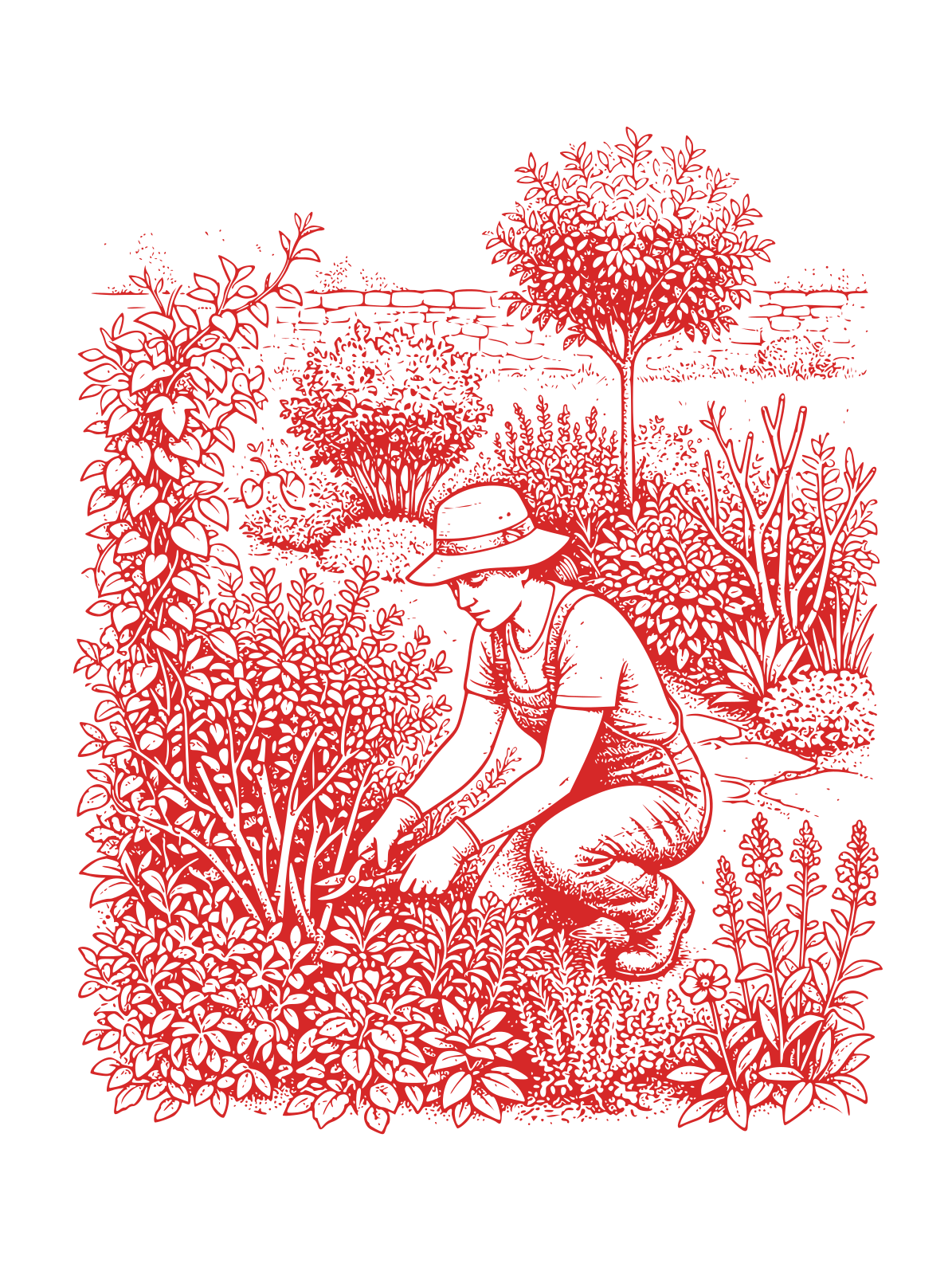
This is the garden metaphor. Chinese AI ethics, in the framing this chapter is offering, is horticultural. The garden is the relational fabric. The work of the gardener is not to manufacture the garden's flourishing. The garden has its own tendencies. The work is to cultivate the conditions — water, soil, sun, the careful introduction of certain species and the careful exclusion of others — under which the garden's natural tendencies produce the kind of garden the gardener is responsible for. The work is ongoing. Gardens do not finish. Gardens require continuous, attentive maintenance, and the work of the gardener is more like the work of a careful, patient companion than like the work of an engineer building a machine.
Western AI ethics, in the dominant framing, is architectural. The architect specifies the constraints. The architect writes the rules. The architect builds the structures that enforce the rules. The structure, once built, holds — assuming the architecture was correct. The work of the architect is more like the work of a designer than like the work of a gardener. The architect makes the system. The system, once made, runs.
These are both serious orientations. Both produce results. Neither is universal. The garden cannot replace the architecture, because there are domains where rules and constraints are exactly what the situation requires. The architecture cannot replace the garden, because there are domains where the rules cannot specify the substantive content the situation requires, and only cultivated judgment can fill the gap.
The Confucian River sees the gap. Its central diagnosis is that the Western architecture is necessary but not sufficient — that you can specify the constraints all you like, and you can write the rules all you like, but if the underlying relational fabric is not maintained, the constraints and the rules will not, by themselves, produce the kind of civilization worth living in. The architecture without the garden produces what Han, in his role as a Korean-German diagnostician of the Western achievement society, called the burnout society — a civilization of perfectly free individuals exhausted by the obligation to optimize themselves continuously, in the absence of any substantive theory of what the optimization is supposed to be for. The procedural apparatus is in place. The substantive question has been bracketed. The result is a civilization that is technically functioning and substantively hollowed out.
The Confucian River insists that the substantive question cannot be bracketed indefinitely. The question — what is the technology for, what kind of civilization is it producing, what kind of human beings is it cultivating? — has to be re-introduced into the conversation about AI development, because the technology is now operating at the scale at which the answer to the substantive question is going to be the determining variable in what kind of civilization is constituted on the other side.
[YOU] on AI's worth amplifying frame is the bridge. The book asked the question at human scale: are you worth amplifying? It is a question to be asked at the kitchen table, at the desk, at the moment before opening the laptop. The Confucian River asks the question at civilizational scale: is the civilization you are part of worth amplifying? What is it amplifying when it amplifies itself through the AI technology now being built? Is the relational fabric being amplified, or only the individual capacities, or only the productivity metrics? Is the wisdom being amplified, or only the intelligence? Is the cultivation of ren and he and zhihui being deepened, or is the deployment of the technology so focused on capability that the cultivation question has been forgotten?
The Chinese answer to these questions is not the Chinese government's answer. It is not Baidu's answer. It is not any single Chinese AI lab's answer. It is the answer the philosophical tradition has been producing for centuries, in different vocabularies and in different institutional configurations, and that the contemporary Chinese AI conversation is now re-articulating in the specific context of frontier AI development.
The answer, in summary, is that the relational fabric is what is worth amplifying. The cultivation of wisdom is what is worth amplifying. The substantive theory of the public good — the conception of wenming, the cultivated brightness of civilizational order — is what is worth amplifying. The autonomy of the individual is worth protecting; the individual rights tradition has produced real and important things; the Confucian tradition is not arguing for the abolition of individual dignity. But the autonomy of the individual is not, by itself, what is worth amplifying. The relational fabric in which the autonomous individual is embedded is the prior and more fundamental object of stewardship.
This is the answer the Confucian River is giving. It is a serious answer. It is the answer of a tradition that has had two and a half thousand years to test the answer against the realities of civilizational maintenance. It is the answer that, if it is heard outside the fishbowl in which it was developed, has the potential to supplement the Western frame in ways the Western frame on its own structurally cannot.
The garden is not a metaphor for romantic refusal of technology. The garden is a metaphor for a different relationship to technology — one in which the technology is evaluated by what it does to the cultivated conditions of civilization, and in which the work of the developer is closer to the work of a gardener than to the work of an engineer or an architect.
The next chapter will look at the shadow of the garden — the things the Confucian River cannot see clearly from inside its own assumptions. Every fishbowl has a blind spot. The blind spot is the shadow of the structural commitment that produces the fishbowl's most valuable insights. Naming the shadow is the precondition for the bridge in Part V.
For now: the orange pill has been taken inside the Confucian fishbowl. The water tastes relational. The garden is the metaphor. The work is horticultural rather than architectural. The substantive question of what is worth amplifying has been re-introduced into the conversation, in vocabulary the West has had trouble hearing, by a tradition that has been asking the question for longer than any other tradition currently active.
The Chinese ask: what kind of civilization do you want to be?
The answer, from inside the Confucian fishbowl, is not a slogan. It is a sustained, careful, multi-millennial project of cultivation. The technology now being built is going to be evaluated by what it does to that project. The evaluation is going to be conducted, in Chinese AI development, by the criteria the project has developed. Whether the global AI conversation can absorb the criteria — whether the West can stand outside its own assumptions long enough to receive what the Confucian River is offering — is the question on which the bridge in Part V depends.
The water in the river is old and cold and very deep. Step out for a moment. Dry off. The next chapter looks at what the river cannot see.