Zheng Yongnian & Jensen Huang — Whether Sovereign AI Is Actually Sovereign
The most structurally revealing pairing in the book.
Zheng Yongnian argues for state-led AI governance from a philosophical position. The civilizational state, on his framework, is a different kind of institution from the liberal-democratic state — one whose legitimacy depends on performance rather than procedure, whose theory of the public good is substantive rather than aggregative, whose relationship to transformative technology is participatory rather than merely regulatory. The state, in this framework, does not merely set the rules under which AI is developed. The state is, itself, an AI deployer with its own theory of what the technology is for and its own legitimate interests in shaping where it goes. The Chinese state's deployment of AI in governance functions is, from this framework, the natural extension of the civilizational state's two-thousand-year history of incorporating transformative technology into the project of governance.
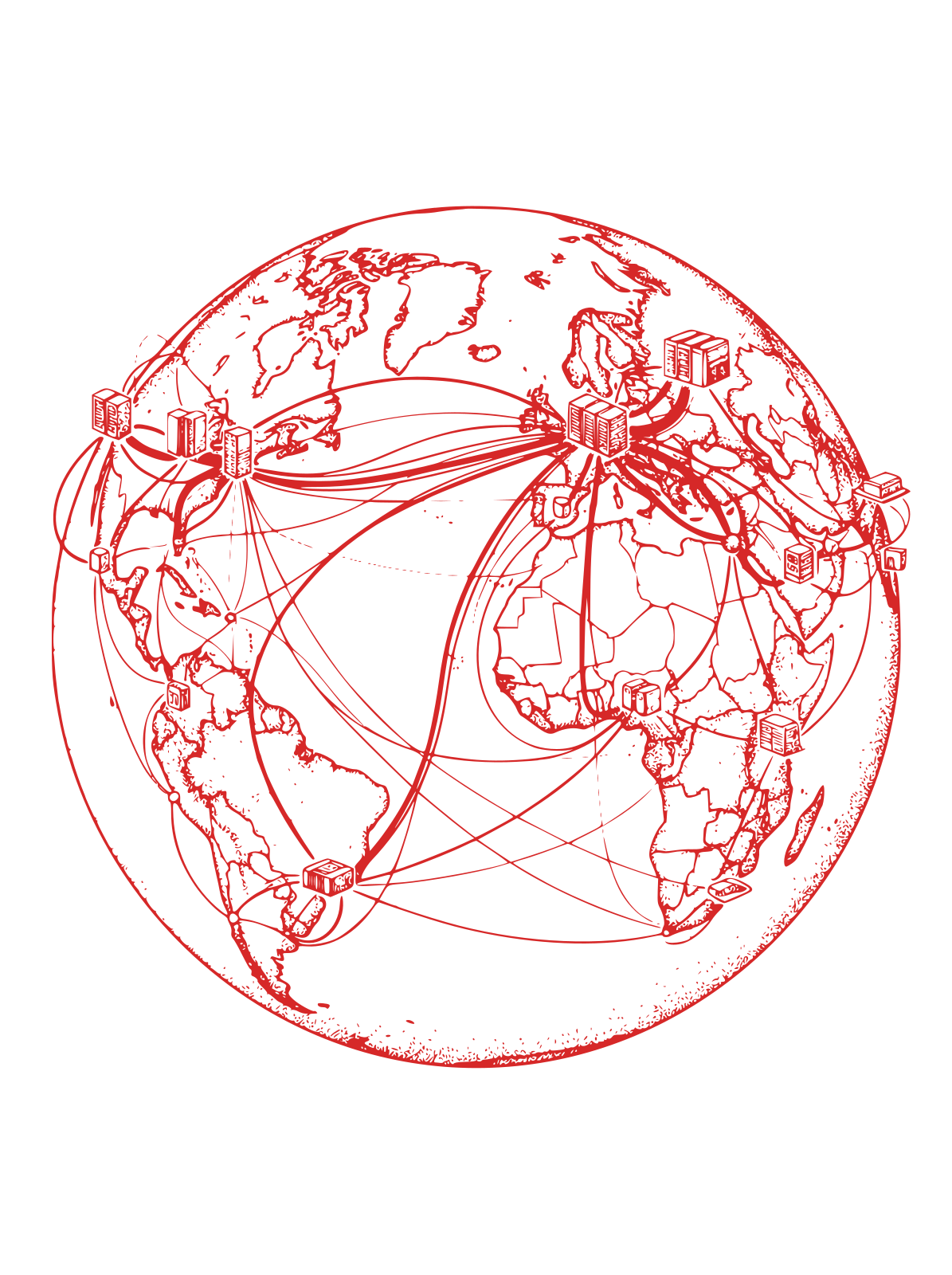
Jensen Huang is building the physical infrastructure for state-led AI and selling it to every state simultaneously — while calling himself a market actor. The sovereign AI thesis, as articulated in NVIDIA's keynote presentations and government-relations work since 2024, is structurally identical to Zheng's argument that nations must own the production of their own intelligence. The geopolitical implication is the same. The institutional implementation is the same physical infrastructure — datacenters within national borders, training stacks on NVIDIA hardware, sovereign clouds that look very much like the same NVIDIA reference architecture deployed under different national branding.
The convergence is the surprise. The Chinese philosophical position and the American market position are producing the same physical infrastructure. The two arguments, articulated in different rhetorical registers and animated by different theoretical commitments, converge on the same recommendation: nations must build their own AI infrastructure.
The convergence is real. It deserves careful attention because it reveals something about the underlying structural situation that neither tradition, articulated alone, makes fully visible.
The underlying situation is this. Intelligence — the productive capacity to generate cognitive outputs at scale — is becoming, in the AI era, a strategic resource of the same order as electricity or steel or oil in earlier industrial eras. A nation that does not have domestic capacity to produce intelligence at the relevant scale is, in the AI era, in something approaching the position of a nation that did not have domestic capacity to produce electricity in the early twentieth century — structurally dependent on whoever has the capacity, with the dependency shaping every other domain of national life. This is the empirical claim that both Zheng's argument and Huang's argument rest on. The claim is, on the available evidence, plausibly correct.
If the claim is correct, then the recommendation that nations must build their own infrastructure follows. From the Chinese philosophical position, the recommendation follows because the civilizational state has a substantive interest in maintaining sovereign capability over the cognitive infrastructure of the nation. From the American market position, the recommendation follows because the buyer's interest is in not being dependent on a single foreign supplier for the strategic resource. The recommendations converge because the underlying structural situation generates the same conclusion through different theoretical paths.
What the convergence reveals is that the categories the discussion has been using — "Chinese state-led approach" versus "American market approach" — have less explanatory power than they appear to have. The Chinese state and the American market, on the question of sovereign AI infrastructure, are producing the same answer. The answer is not a function of the political system. The answer is a function of the structural situation. Whatever theoretical apparatus you bring to the situation, if you take the empirical claim seriously, you arrive at the same recommendation.
This is the place where the categories crack open. The conventional framing — that the West is for free markets and individual liberty and the East is for state control and collective good — does not survive contact with what is actually being built. The actual physical infrastructure of sovereign AI looks the same in every country that has adopted the thesis. The same NVIDIA reference architecture, the same data center configurations, the same training stacks, the same inference hardware. The differences are at the level of how the infrastructure is being used and what the substantive content of the AI being trained on it is. Those differences are real and matter. The infrastructure itself does not.
The divergence between Zheng and Huang is in the framing of the convergence. Zheng frames it as a political imperative — the civilizational state must own the production of its own intelligence because the public good substantively requires it. Huang frames it as a product-market fit — the buyer's interest requires it, and NVIDIA happens to be the vendor that can supply it at scale. The two framings produce the same purchasing decisions. The two framings produce different conceptions of what the purchasing decisions mean.
The Zheng framing locates the substantive responsibility for what the AI does in the civilizational state. The state is the substantive actor. The state has obligations to the public good. The state's deployment decisions are subject to the substantive criteria the Confucian tradition has articulated. The infrastructure is sovereign in the sense that the substantive decisions about what to deploy and how to deploy it are being made by the institution responsible to the substantive criteria.

The Huang framing locates no substantive responsibility anywhere in particular. NVIDIA sells the substrate. The buyers — nations, labs, corporations — make their own decisions about what to deploy and how to deploy it. The substrate is indifferent. The substantive question of what is being amplified is delegated to the aggregate of buyer decisions. The infrastructure is sovereign in the sense that the buyers can do whatever they want with it. The substrate provider does not, by virtue of providing the substrate, take on substantive responsibility for what the substrate is used for.
These are different framings of the same underlying physical situation. They produce different conceptions of what governance requires.
What this reveals is something the American discourse has had trouble seeing. Supply allocation is soft power — which is, in different vocabulary, Zheng Yongnian's point made in American. The substrate provider that controls the bottleneck input to intelligence production is exercising a form of substantive power over global AI development, whether or not the substrate provider conceives of itself as doing so. The discretionary allocation decisions about which customers receive which generations of chips at which speeds are decisions with substantive consequences for the trajectory of every customer's AI program. The decisions are not subject to external oversight. The decisions are not accountable to any electorate. The decisions are made by the allocation team at the substrate provider, in collaboration with the substrate provider's CEO, with reference to commercial criteria that include but are not limited to geopolitical considerations imposed by US export controls.
This is, by any substantive analysis, sovereign decision-making. It is sovereign decision-making by a publicly traded corporation in Santa Clara whose discretionary authority shapes the cognitive infrastructure of every nation on earth that buys from it. The American market framing has trouble registering this as sovereign decision-making because the framing reserves the term "sovereign" for political institutions. The Chinese civilizational state framing has no such difficulty. Zheng's framework would treat NVIDIA's allocation decisions as the exercise of substantive power that, in any coherent governance framework, would be subject to substantive accountability.
The fact that the decisions are not subject to substantive accountability — that the substrate provider exercises sovereign power without sovereign responsibility — is one of the most underdiscussed structural features of the AI moment. The categories crack open. The Chinese philosophical position and the American market position converge on the same recommendation (sovereign infrastructure) and diverge on the question of substantive responsibility (Chinese frame: the state; American frame: nobody in particular).
What this chapter has tried to do is make the convergence and the divergence visible at the same time. The convergence reveals that the political categories ordinarily used to organize the discussion are less explanatory than they appear. The divergence reveals what is actually at stake — the question of substantive responsibility for what the technology is for. The Chinese frame locates the responsibility. The American frame, in its market commitments and its institutional concentration of substrate provision in a small number of private corporations, leaves the responsibility unlocated.
The unlocation is not a feature. It is a structural problem. The substrate provider exercises substantive power. The substrate provider, in its institutional structure, is not responsible to the populations whose lives are being shaped by the exercise of the power. The accountability gap is real. The accountability gap is widening as the substrate's role in the global cognitive infrastructure deepens.
The next chapter — Kai-Fu Lee and Elon Musk — addresses what happens when the substantive question of what AI is for is asked by builders who have been forced, by personal circumstance, to confront the question more directly than the procedural apparatus would otherwise permit. The answer they arrive at is unexpectedly convergent in some places and unexpectedly divergent in others. The convergence is on the recognition that something irreducible to optimization is what we are actually trying to protect. The divergence is on what that something is and what protecting it requires.
The fishbowls are visible. The water from both rivers is mingling in the same lake of global compute infrastructure. The substantive question of what is being amplified through that infrastructure remains, in each tradition's articulation, partially unanswered. The conversation that would produce the complete answer has not yet happened. The book is the attempt to put both halves of the answer on the same page.