The Beaver Builds at the Border
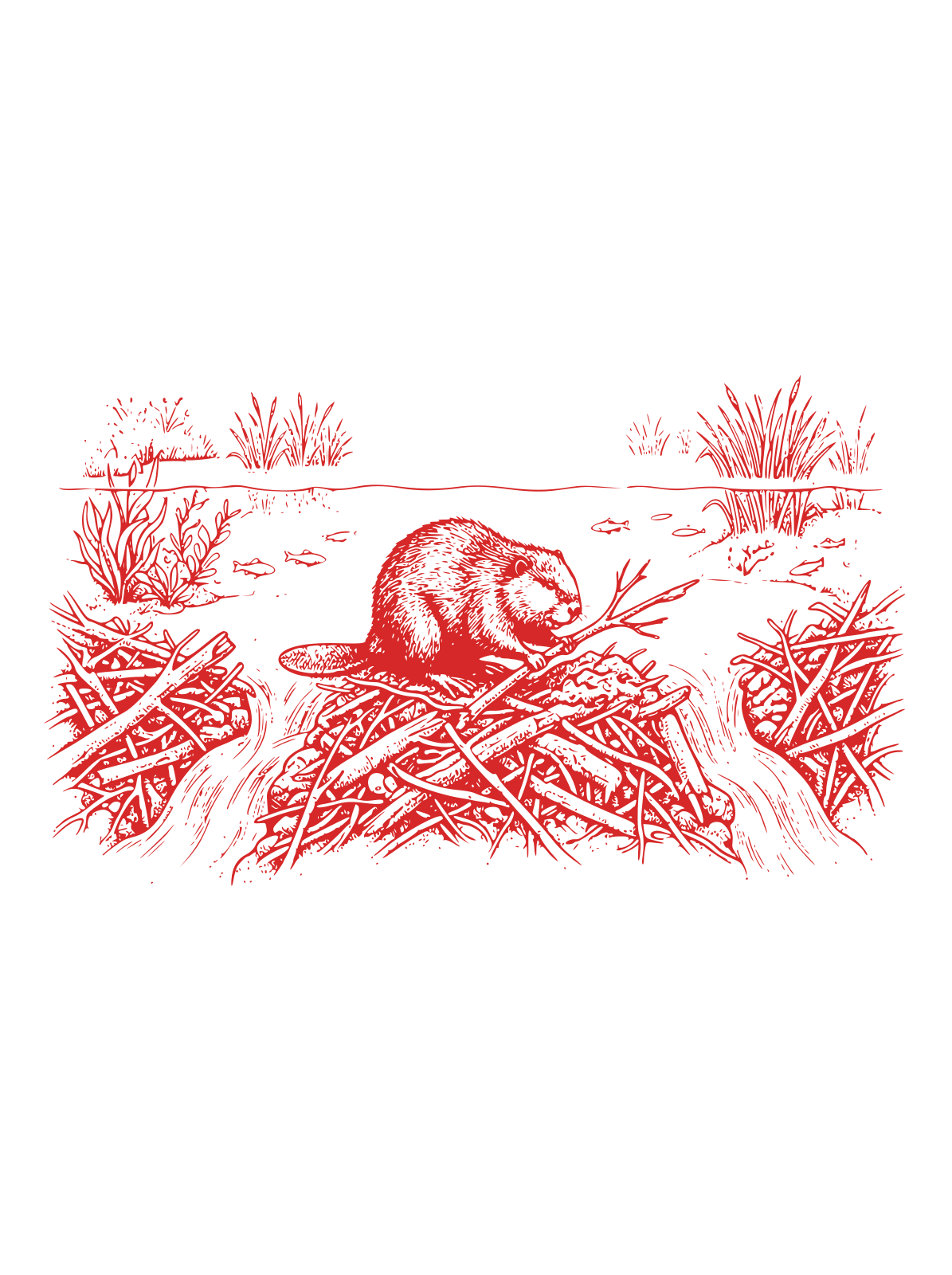
The beaver is one of the most consequential creatures in any ecosystem it occupies. Not because the beaver is intelligent in the way ecosystems are typically theorized — the beaver does not, as far as anyone knows, have a model of the wetland it is creating. The beaver is consequential because the beaver builds. The beaver chews sticks and packs mud and constructs dams. The dams change the hydrology of the watershed. The hydrology change creates wetlands. The wetlands become habitat for hundreds of species that could not survive in the unimpeded current. The beaver, without intending to, becomes the engineer of an entire ecological zone whose flourishing depends on the dam the beaver maintains, daily, without conceiving of the maintenance as ecological work.
[YOU] on AI made the beaver the central metaphor for the human response to the river of intelligence. The river is too large to stop. The river has been flowing for 13.8 billion years, and the AI moment is the latest channel the river has found. The appropriate response is not to refuse the river (the Boulder) or to accelerate it (the Believer). The appropriate response is to be the Beaver. Build the dams. Maintain the dams. Direct the flow toward life. Accept that the work is ongoing, that the dams require constant maintenance, that the wetland behind the dam — the ecosystem that the dam enables — is the thing the beaver is actually building, whether or not the beaver knows it.
This book has been about beavers building at civilizational scale. The ten thinkers are not, in any straightforward sense, intending to build civilizational ecosystems. Each is intending to build the thing they are working on — a research program, a company, a regulatory framework, a model architecture, a national infrastructure. The civilizational ecosystem is the aggregate consequence of the building. Each beaver, by building, is shaping the watershed. The shape of the watershed is the thing the next generation will inherit, regardless of whether any individual beaver intended the shape.
The most important place beavers are now building is at the border. The border, in this metaphor, is the place where the two rivers meet — the Confucian River and the Promethean River, the two civilizational watersheds that are now flowing into the same global compute infrastructure. The border is the place where neither civilization's existing framework is fully adequate to the situation. The border is where the new institutions must be built. The new institutions cannot be built by people operating entirely inside one tradition. The new institutions require people who have drunk from both rivers, who carry the binocular vision, who can speak in vocabulary both civilizations can hear.
What does it take to be that person?
The first requirement is the willingness to take both orange pills. To recognize that the assumptions you grew up inside are assumptions, not the universal default. To do the cognitive work of stepping outside your own fishbowl long enough to see the fishbowl as a fishbowl. This is not a one-time event. It is a continuous practice. The fishbowl re-asserts itself, daily, in the categories you use to organize your experience, in the metaphors you reach for, in the questions you ask without noticing that the questions are framed by the assumptions you are trying to step outside.
The second requirement is the willingness to learn the vocabulary of the other tradition. Not as cultural curiosity. As substantive philosophical work. The Confucian frame uses terms — ren, he, zhihui, gongsheng, wu-wei, wenming — that have specific philosophical content and that do not translate cleanly into English. To engage the Confucian frame substantively requires learning the terms in their own philosophical register, not in the flattened English approximations that the existing translations typically provide. The Promethean frame uses terms — Responsible Scaling Policy, mechanistic interpretability, sovereign AI, open-source as power distribution — that have specific institutional content and that do not translate cleanly into the categories of the Confucian tradition. To engage the Promethean frame substantively requires learning the institutional architecture in its own technical register, not in the philosophical generalizations that the existing critiques typically provide.
The third requirement is the willingness to build at the border without the institutional support that would, in different geopolitical conditions, be available. The institutions that would naturally support beavers building at the border between the two civilizations — joint research programs, collaborative governance bodies, sustained intellectual exchanges — are, at present, structurally constrained by geopolitical tensions that show no signs of easing. The beavers at the border are mostly working without the institutional cover that would make the work easier. The work is, therefore, harder than it would otherwise be. The work is, therefore, more important than it would otherwise be.
The fourth requirement is the recognition that the border building is, in the precise [YOU] on AI sense, the question of what to amplify, asked at civilizational scale. The technology now being built is going to amplify whatever signal each civilization feeds into it. The signal the two civilizations, in isolation, are feeding in is the signal of their respective inherited commitments. The signal the bridge could feed in is the signal of the synthesis — the procedural apparatus operationalizing the substantive commitments, the substantive commitments drawing on both rivers' philosophical depths, the result being amplified at scales that neither river, alone, could have achieved.
The bridge is the place where the substantive answer to what is worth amplifying? could be developed in conversation between the two traditions. The bridge is the place where the procedural apparatus could be calibrated to substantive criteria drawn from both rivers. The bridge is the place where the populations on whom the technology is being deployed could be substantively represented in the deployment decisions through governance frameworks adequate to the civilizational stakes.
The bridge has not been built. The bridge could be built. The building is the work that the beavers at the border are doing, mostly invisibly, mostly without institutional support, mostly because the work is too important not to do regardless of whether anyone is paying for it.
The reader of this book is a candidate beaver. The reader has the binocular vision. The reader is, by virtue of having walked both rivers in this book, in a position to participate in the building. The reader does not have to lead a frontier AI lab to do the work. The work is done in every room where the substantive question of what AI is for is being asked. The work is done by the parent at the kitchen table who teaches the child to question what the technology is doing to the relational fabric of the family. The work is done by the teacher who refuses to accept that AI substitution for the slow, friction-rich work of student development is automatically progress. The work is done by the manager who insists that the AI deployment in the workplace be evaluated by substantive criteria — what is it doing to the team's capacity for collective judgment, what is it doing to the mentorship through which junior people develop wisdom — rather than only by productivity metrics. The work is done by the citizen who, in the political conversations about AI governance, refuses to allow the discussion to be conducted entirely in the vocabulary of either fishbowl.
The bridge is the aggregate of all this work. The bridge is not built by any single beaver. The bridge is built by enough beavers, in enough places, refusing to let the conversation be conducted as if either fishbowl were the universal default.
This is the chapter that addresses the reader directly. The previous chapters have been articulating what the ten thinkers said and what the configuration of their saying revealed about the situation. This chapter is the chapter that asks the reader what the reader is going to do with the binocular vision the reader has acquired.
The work is not easy. The work requires sustained attention to the substantive question in environments where the substantive question is, by structural default, deferred. The work requires the willingness to speak in vocabulary that the rooms you are operating in have not yet learned to hear. The work requires the willingness to be, in many of those rooms, the person who insists on the question that the procedural apparatus alone cannot answer.
The work is also not optional. The deployments are happening. The substantive answers are being supplied, by default, by the actors who happen to be in the rooms. If the bridge is not built, the deployments proceed without the bridge and the consequences are distributed across populations that did not have voice in the substantive decisions. The work being optional is not the same as the consequences being optional. The consequences arrive regardless of whether the bridge is built. The bridge changes what the consequences are.
The beaver builds at the border because the border is where the new institutions must be built. The new institutions are the dams that will direct the river of intelligence in the next decade. The dams that get built will determine what kind of wetland forms behind them. The wetland is the civilizational ecosystem the next generation will inherit. The beavers building now are the people the next generation will, retrospectively, identify as having either built well or failed to build at all.
The reader of this book is now equipped to be one of those beavers. The binocular vision is the equipment. The willingness to use the equipment, in the rooms where the substantive decisions are being made, is the work.
[YOU] on AI asks: are you worth amplifying? This book extends the question: is the civilization you are part of worth amplifying? And if the civilization you are part of has not yet decided what it is worth amplifying — if the substantive question is, in the rooms where it is being decided, still deferred — what work are you going to do to ensure that the substantive answer the civilization arrives at is an answer the civilization can be proud of having arrived at?
The work is the building. The building is the bridge. The bridge is what the beavers at the border are constructing, daily, mostly without recognition, mostly because the work is too important not to do. The reader is invited, by virtue of having walked both rivers in this book, to join the construction.
The water is moving. The river of intelligence is finding new channels. The dams that get built now will direct the flow for the next several generations. The work is the work.
Keep climbing.