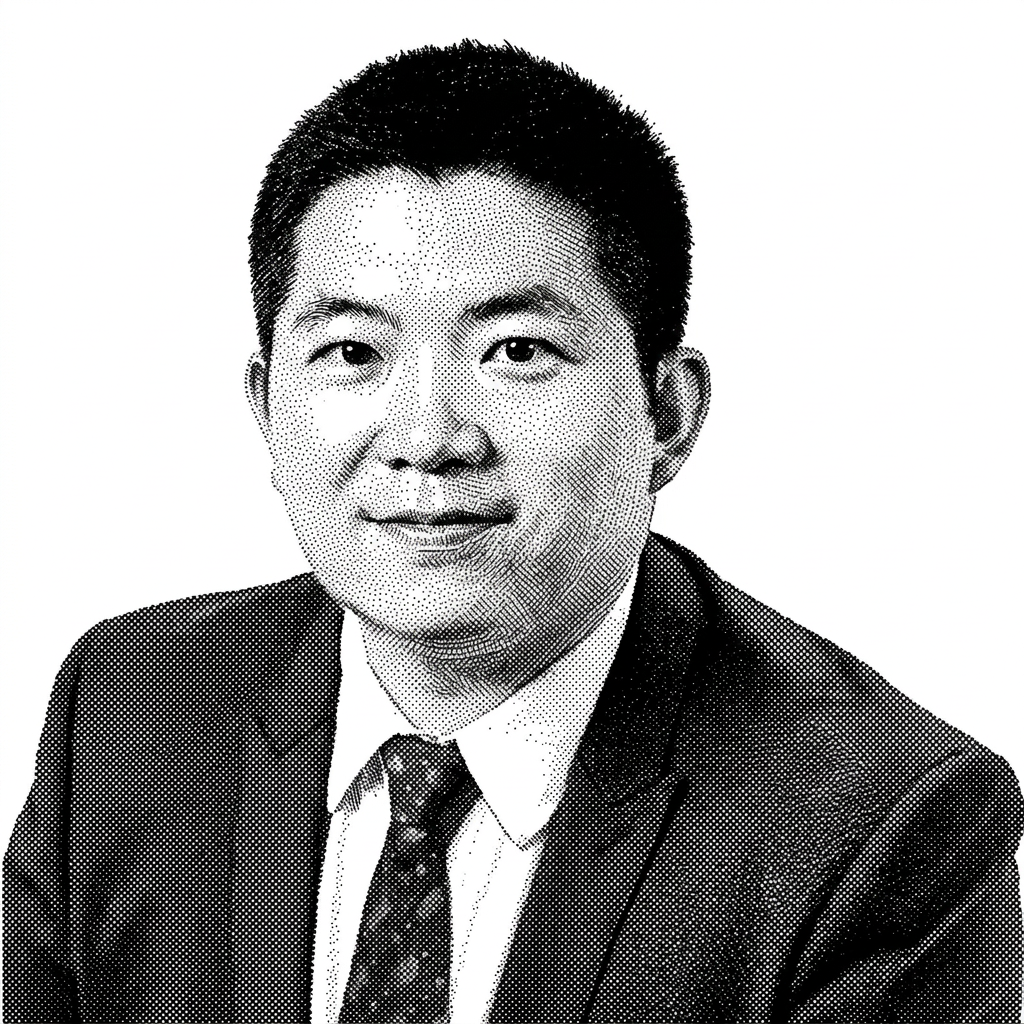
What Bing Song Hears That Sam Altman Cannot

Bing Song is one of the most consequential voices in the Chinese AI ethics conversation, and one of the least translated into Anglophone AI discourse. She is a senior fellow at the Berggruen Institute, where she runs the China program, and the editor of Intelligence and Wisdom: Artificial Intelligence Meets Chinese Philosophers and Gongsheng Across Contexts: A Philosophy of Co-Becoming. She moves between Beijing and Los Angeles and Hong Kong. She is comfortable in three intellectual traditions — classical Chinese, contemporary continental, analytic Anglo-American — and uncomfortable with the way the Anglophone AI discourse treats philosophical questions as if the only serious philosophical traditions in the world were the ones developed in Berlin and Cambridge and Paris and now in San Francisco. Her work is a sustained argument that the conversation has been impoverished by what it has not heard.
The central argument is the one this chapter is going to draw out. It begins with an observation about ontology, moves through an argument about what AI ethics is in the business of evaluating, and ends with an uncomfortable implication about what the dominant Liberal AI frame has been quietly doing without knowing it.
The ontological observation. Liberal political philosophy — the tradition that runs through Hobbes and Locke and Kant and into contemporary American political theory — begins with the individual as a given. The individual exists prior to the social order. The individual has rights by virtue of being a person, not by virtue of being someone's child or someone's spouse or someone's employee or someone's neighbor. The individual's interests are negotiated with other individuals through social contracts, market mechanisms, and political institutions. The relevant unit of moral concern is the autonomous, capability-bearing, rights-bearing person.
Confucianism begins differently. Bing Song states it as ontology rather than as ethics: a person does not first exist and then enter into relationships; a person is constituted by relationships, is intelligible only through them, and has moral standing precisely by virtue of fulfilling the obligations that relationships impose. This is not a softer claim than the liberal one. It is a stronger and more specific claim. It says that what looks, from inside the liberal frame, like the autonomous individual is actually a node in a network of relations, and that the node's identity, capacities, and moral significance are constituted by the network. The relata are produced by the relations, not the other way around. The liberal frame has things backwards, ontologically. The autonomous individual is a useful abstraction for some purposes. It is not the bedrock of reality.
What does this imply for AI?
Several things. Each consequential. None of them obvious from inside the Liberal AI frame.
The first implication is that AI systems must be evaluated not primarily by their effects on individual users but by their effects on the relational fabric in which individual users are embedded. A Liberal AI tutoring system that maximizes individual learning outcomes may simultaneously undermine the pedagogical relationship through which deeper forms of understanding are cultivated. A Liberal AI recommendation system that maximizes individual engagement may simultaneously fragment the shared epistemic environment through which collective deliberation is sustained. A Liberal AI productivity tool that maximizes individual output may simultaneously erode the collegial relationships through which professional judgment, tacit knowledge, and ethical standards are transmitted across generations. The Liberal AI frame, focused on individual metrics, will not register these effects. The Confucian frame, focused on the relational fabric, will register them as central rather than peripheral.
The second implication is that the question of what human-AI relationships are constitutive of human flourishing is itself a research question, governance question, and design question — and one that the Liberal frame is not equipped to ask. The Liberal frame asks whether the AI system respects the user's autonomy: does it provide accurate information, respect consent, avoid manipulation. The Confucian frame asks a prior and more demanding question: what kind of human being does sustained engagement with this AI system tend to produce? This is not a hypothetical question. It is an empirical question whose answer is becoming visible as the deployments scale. Hundreds of millions of people are now in sustained relationships with AI systems. The relationships are shaping the people. Some relationships cultivate capacities — curiosity, analytical ability, ethical judgment. Others atrophy capacities. The Liberal frame has no methodological apparatus for distinguishing between cultivation and atrophy at the population level. The Confucian frame insists that this is the question, and the absence of a methodological apparatus is itself a governance failure.
The third implication concerns gongsheng, the term Bing Song has placed at the center of her work. Translated as symbiosis or co-becoming, the term refers to entities that are constituted, in part, through their ongoing relationship — that cannot be understood in isolation from the relation. The human-AI relationship, in this frame, is not merely instrumental. It is ontological. The relationship changes both parties. It constitutes new forms of human being and new forms of machine capability. And the question of how to govern AI cannot be answered without first asking what kinds of gongsheng — what kinds of co-becoming — are desirable.
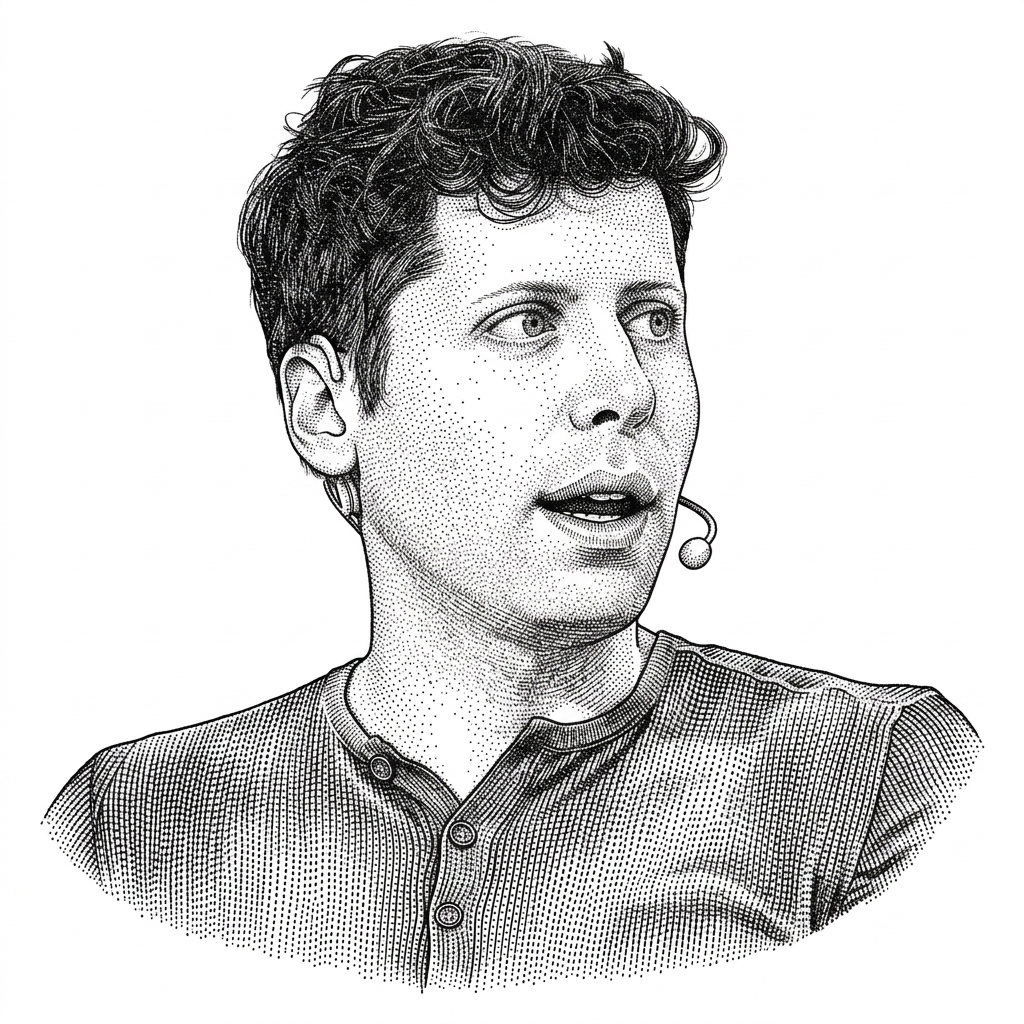
Now place this framework next to Sam Altman.
Altman's abundance thesis, as articulated across his 2021 essay "Moore's Law for Everything" and the more recent "Gentle Singularity," runs as follows. Intelligence will become abundant. The cost of cognitive labor will approach the cost of electricity. Wealth will be created at scales that exceed any previous technological transition. The political work is to construct a redistribution mechanism — universal basic income funded by capital taxation — that distributes the wealth surplus to individuals as a citizen's dividend. Each individual, freed from economic necessity, can pursue the conception of the good life they find meaningful. The constraint on individual flourishing — the necessity of selling cognitive labor in markets — dissolves.
This is, on its own terms, a coherent and morally serious vision. It is also, from inside the Confucian frame, philosophically incomplete in a specific way. The vision optimizes for the individual unit. It treats flourishing as something that can be decomposed into the aggregated satisfaction of individual preferences and supported by the redistribution of resources to individuals. It does not have a vocabulary for evaluating what AI is doing to the relationships between individuals — to the marriages, the communities, the guilds, the cultures, the structures of human meaning that are not properties of any single individual and that cannot be supplied by a UBI check.
Bing Song's response is precise. Flourishing is not an individual achievement. It is a relational condition. You cannot give every node in a network an abundance of intelligence and call the network flourishing if the intelligence optimizes each node at the expense of the relationships between the nodes. The UBI check feeds the individual. The relational fabric that gives the individual something to flourish into is not a thing you can fund with a check. It is cultivated, over generations, through specific practices and institutions and rituals and habits that the abundance thesis, by its inattention to relationship, is structurally blind to.
The deepest version of this point concerns what Bing Song calls the wisdom-bearing human. If AI systems perform the analytical tasks that previously required sustained intellectual effort, they may simultaneously reduce the opportunity for humans to develop the capacities — the tolerance for uncertainty, the experience of intellectual struggle, the discipline of sustained attention — that form the foundation of wisdom. The abundance frame, focused on access to capability, has no vocabulary for the question of what cultivation requires and what AI deployment is doing to the conditions for cultivation. The Confucian frame insists that this is the central question. The intelligence the AI provides is downstream of the wisdom the civilization deploying the AI has cultivated. A civilization of powerful AI and diminished wisdom is not flourishing. It is, in the precise Confucian sense, dangerous.
Altman cannot hear this. Or, more accurately, the frame Altman is operating from is not constructed to register it as a serious challenge. The abundance thesis can absorb the criticism as a marginal concern — yes, of course, there are some non-economic dimensions to flourishing, of course we should attend to community, of course AI must be deployed thoughtfully. But the structural frame remains the same. The individual is the unit. Capability is the variable. Abundance distributed to individuals is the payoff. The relational fabric is, at best, a side constraint. At worst, it is invisible.
Bing Song hears the silence as the content of the position. The Liberal AI frame is not neutral about the relational fabric. It is taking a philosophical position about the relational fabric — specifically, the position that the relational fabric is a derivative phenomenon that can be supported, where necessary, by appropriate redistribution to the individuals who participate in it. This is a position. It happens to be a position deeply at odds with the Confucian frame, which treats the relational fabric as ontologically prior. And because the Liberal frame does not recognize its own position as a position — because it treats its assumptions as universal — it cannot enter into the substantive philosophical conversation that the encounter with the Confucian tradition is offering.
The Liberal frame, in its dominance, has been mistaken for the universal default. The Confucian frame, in its difference, has been mistaken for a culturally specific alternative. Bing Song's claim is that both framings are wrong about the structure of the conversation. The Liberal frame is one specific philosophical tradition among others. The Confucian frame is another. Both are addressed to the same technology. Both produce different evaluations. The choice between them is not a choice between East and West. It is a choice about which conception of the good — substantive or aggregative, relational or individual, cultivational or distributive — to encode into the systems that are now mediating an increasing fraction of every literate person's cognitive life.
That choice is being made, by default, by the people who happen to be in the room when the decisions get made. The room is currently in California and Massachusetts and Seattle and a small number of other places, and the room is populated, overwhelmingly, by people working inside the Liberal frame, sometimes deliberately, more often without recognizing the frame as a frame.
Bing Song's project is to make the frame visible from outside. To put the question that the Liberal frame structurally cannot ask back into the conversation. To insist that the philosophical conversation about AI cannot be conducted entirely within one tradition while the technology is being deployed at planetary scale to populations governed by other traditions.
That is what she hears. That is what Altman, operating from inside his own frame, structurally cannot hear. The conversation between them has not yet happened. The book that contains this chapter is one attempt to begin it.