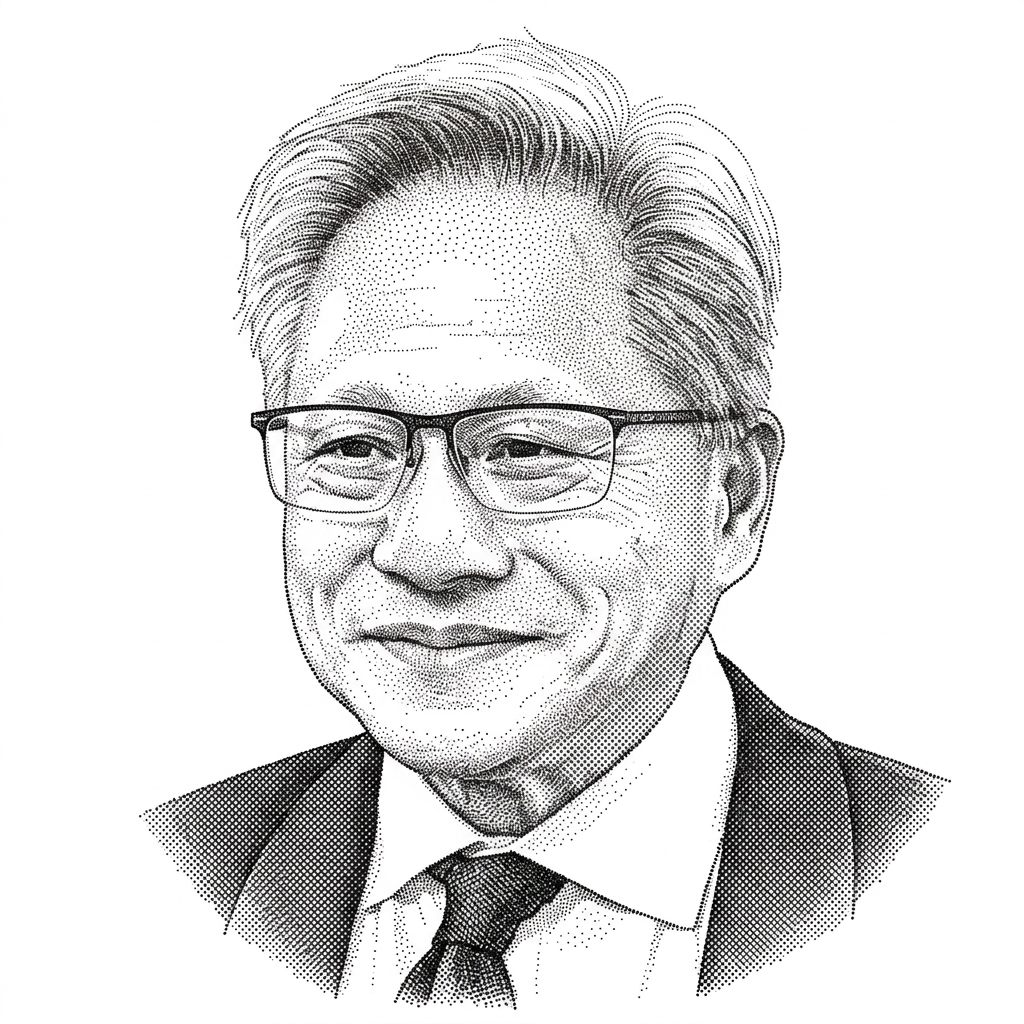
Jensen Huang — Supply Allocation as Soft Power

"Every country must own the production of its own intelligence" is simultaneously the most compelling geopolitical argument for AI investment and a three-to-five-trillion-dollar TAM assertion delivered by the man whose company will sell every sovereign their factory. The conflict of interest is so structurally total it deserves analysis on its own terms.

Jensen Huang delivered the formulation at the World Governments Summit in Dubai in 2024 and has elaborated it in keynote appearances, government meetings, and op-eds across the world. The argument, in its strongest form, is this: data is the substrate of intelligence; data is national; therefore, the means of producing intelligence from data must also be national. To outsource the production of intelligence to foreign infrastructure is to surrender sovereignty over the cognitive products that increasingly shape national life — economic policy, defense doctrine, public health management, education systems.
The argument is real. It is not invented to sell chips. National data sovereignty is a recognized concept in international law and policy. The question of whether a nation's most strategically significant computations should occur on infrastructure owned and operated by a foreign company is not frivolous. The European Union has wrestled with it. India has wrestled with it. Saudi Arabia and the UAE are in the middle of wrestling with it. Japan, France, Italy, Singapore, Canada, the United Kingdom — all of them have announced sovereign AI initiatives in the wake of Huang's framing. The framing did not invent the concern, but it did organize and articulate it in a way that turned diffuse anxiety into concrete investment programs.
It is at this exact point that the conflict of interest becomes structurally total. The man making the most articulate case for sovereign AI is also the man whose company will receive most of the resulting capital expenditure. The reference architecture for a sovereign AI cluster is, in practice, an NVIDIA reference architecture. The training stack is NVIDIA's. The networking is NVIDIA's. The inference hardware is NVIDIA's. The Omniverse and Isaac platforms that get bundled into the simulation and robotics components are NVIDIA's. There is no version of sovereign AI under the current technological geometry that does not flow most of its dollars to one Santa Clara company.
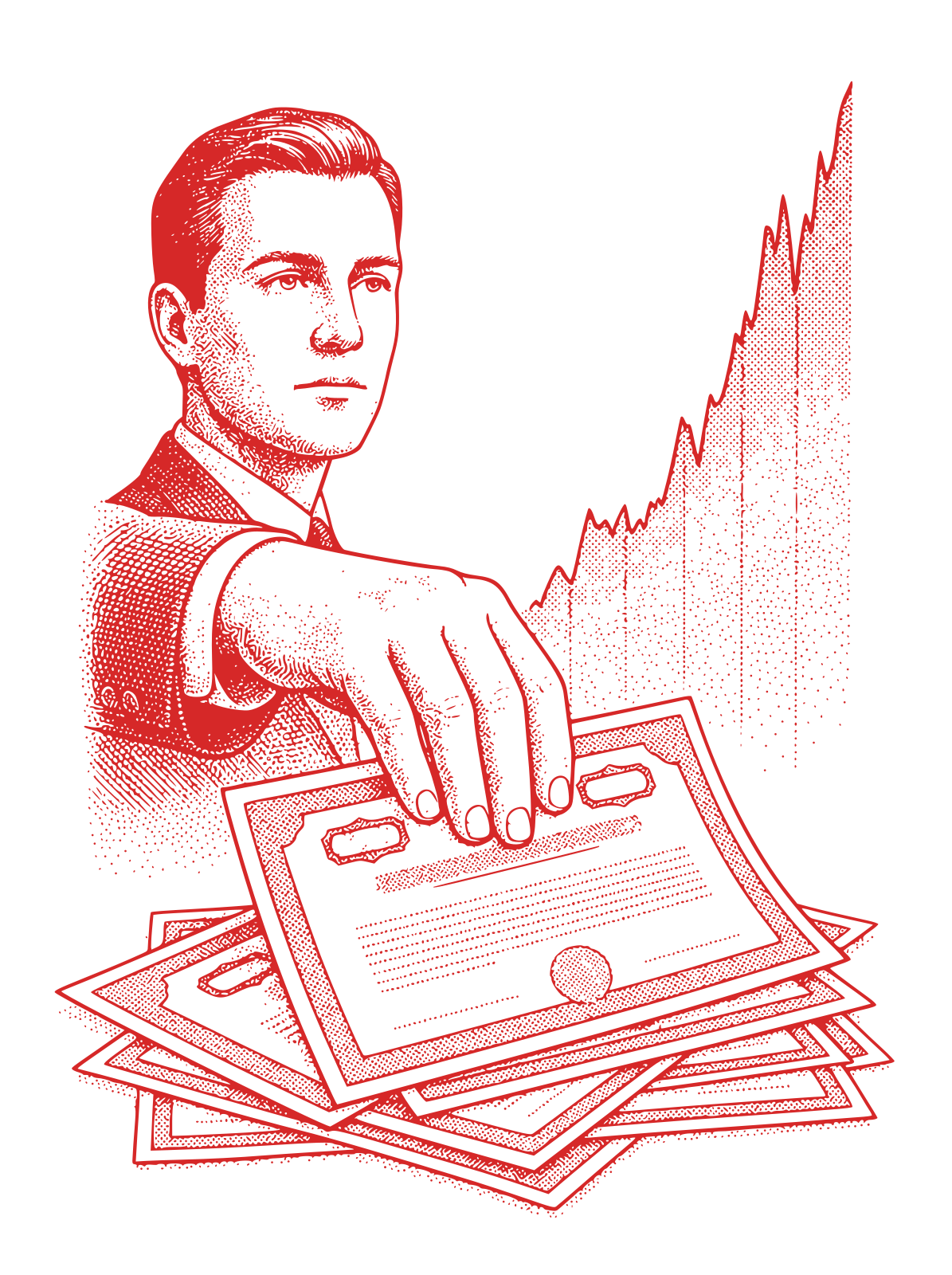
This is not a hypothetical objection. It is observably the case. The Saudi HUMAIN program, the UAE's G42 partnership, India's IndiaAI mission, Japan's sovereign cloud projects, the EuroHPC accelerator initiatives — all of them route significant fractions of their budgets through NVIDIA hardware. The sovereign AI thesis, in its current institutional implementation, is the most successful single sales argument in the history of industrial computing. Whether the resulting national capabilities will actually be sovereign in any meaningful sense is a different question, and one the framing does not encourage governments to ask.

There are at least three distinct levels of sovereignty at stake, and the framing tends to elide them. The first is jurisdictional sovereignty: the data and the computations physically reside within the nation's borders. This level is achievable with NVIDIA hardware and is often achieved. The second is supply-chain sovereignty: the nation can continue to operate the infrastructure even if external supply is interrupted. This level is much harder. A national AI cluster depends on continued access to new generations of chips, to software updates, to spare parts, to specialized engineering support — none of which is sovereign even if the data center sits inside the national border. The third is design sovereignty: the nation can determine the architecture and direction of its own AI capabilities, including the option to substitute alternative substrates. This level is nearly impossible under the current arrangement, because the alternative substrates do not exist at scale.
Huang's framing emphasizes the first level, the easiest to deliver and the one most aligned with his commercial interest. The second level is acknowledged but treated as a function of having a good relationship with NVIDIA — which is to say, treated as a relationship, not a sovereignty. The third level is largely unmentioned, because acknowledging it would undercut the entire commercial proposition. This is not duplicity. It is the rational rhetoric of a salesman selling a real product. But it is also the kind of structural omission that public-interest analysis is supposed to surface.
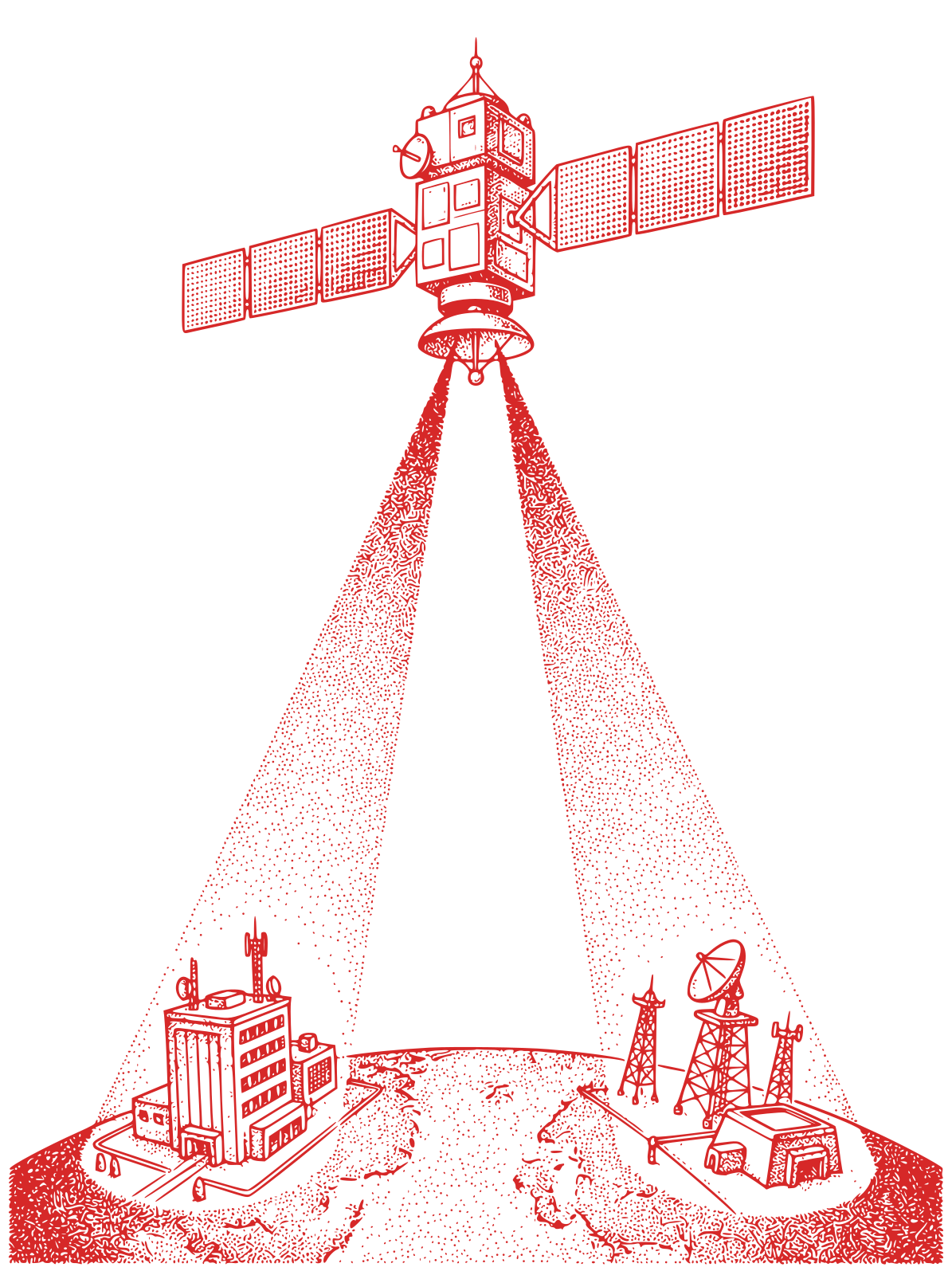
The geopolitical implications cascade. If every major nation builds out NVIDIA-based sovereign capacity, the result is not a multipolar AI world. It is a uni-substrate AI world with multiple jurisdictions, all dependent on the same vendor for their supposedly sovereign capabilities. This is a peculiar geometry. It resembles less the multipolar Westphalian system that "sovereignty" rhetoric invokes and more a feudal arrangement in which multiple lords pay tribute to a single craftsman for the swords with which they fight each other.
The companion phenomenon, supply allocation as soft power, is the operational form of this concentration. When NVIDIA allocates H100s and B200s across hyperscalers, sovereign nations, and frontier labs simultaneously, it is exercising a form of geopolitical discretion no elected government granted it. The company that controls the scarcest input to intelligence is operationally a new kind of state actor. This is not metaphor. In 2024 and 2025, the question of which Microsoft, Google, Meta, Amazon, OpenAI, Anthropic, xAI, or sovereign customer received how many of the latest-generation chips was decided by NVIDIA's allocation team in collaboration with Huang himself, and the decisions had measurable consequences for the trajectory of each customer's AI program. The allocation discretion was not subject to any external oversight mechanism. It did not need to be justified to any electorate. It was simply exercised.
The discretion is structural, not accidental. Frontier-class GPUs are supply-constrained because TSMC's advanced-node capacity is itself constrained, because high-bandwidth memory is constrained, because the packaging and testing infrastructure is constrained. The result is that demand persistently outruns supply at the frontier. The allocation decision is therefore not whether to sell but to whom. When demand exceeds supply by a factor of two or three or five, the seller is choosing who gets to do frontier research and who has to wait.
The criteria are not published. They include, by reasonable inference, customer relationships, strategic importance, payment terms, the perceived likelihood that the customer will use the chips productively, and geopolitical considerations imposed by US export controls. The last factor is particularly significant. Since 2022, the United States government has progressively restricted what NVIDIA can sell to China at the frontier, and the company has navigated those restrictions by producing intermediate-tier products designed to comply with shifting controls while preserving access to a critical market. The product variants — A800, H800, B30 — exist because the company is operating as a partial agent of US trade policy.
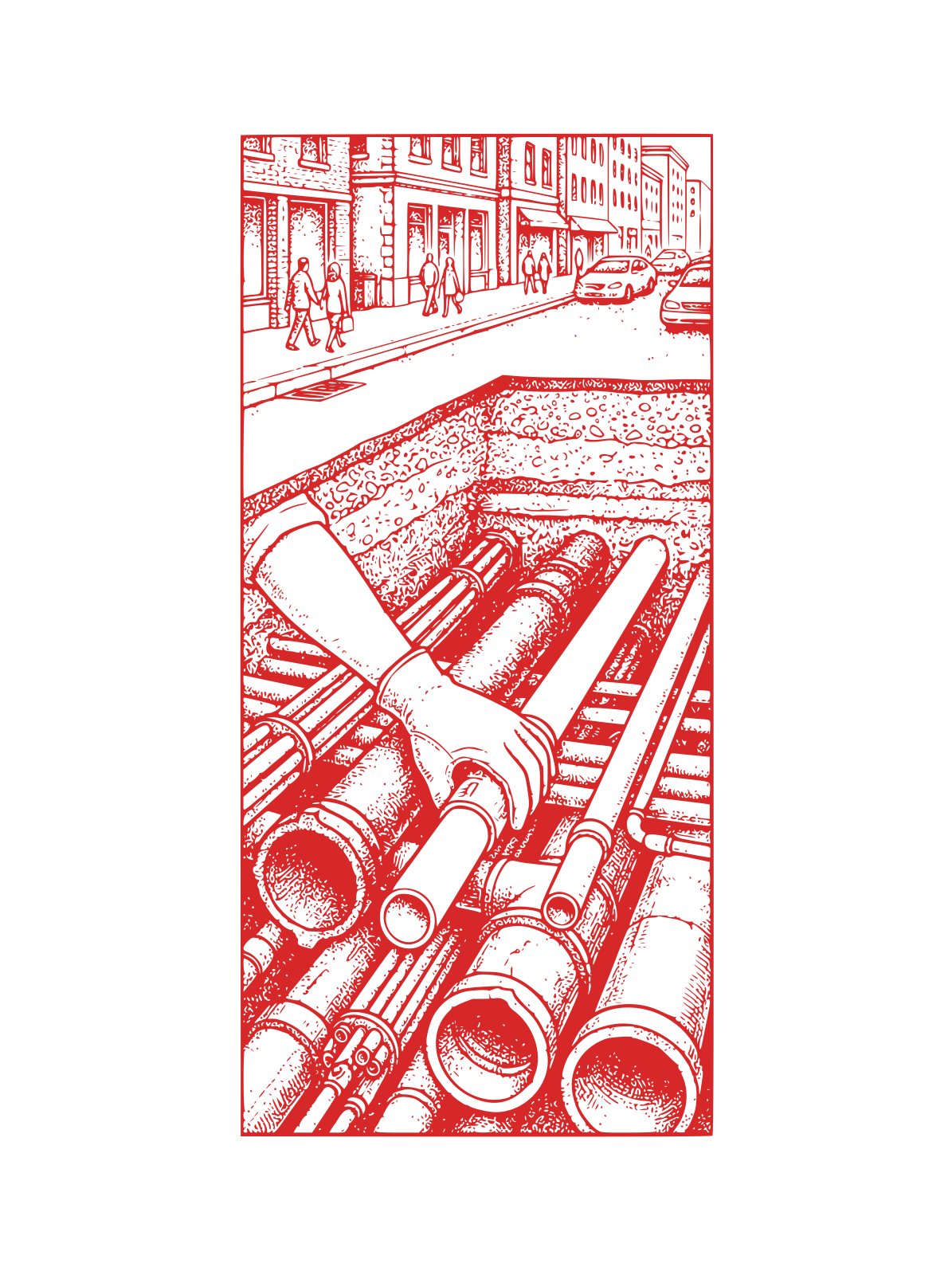
There is something analytically novel here. NVIDIA is not regulated as a utility, even though its products have the structural significance of one. It is not chartered as a state-owned enterprise, even though its allocation decisions shape national capabilities. It is not even classified as critical infrastructure in a way that imposes binding public obligations. It is a publicly traded corporation that happens to control the bottleneck input to the most strategically significant technology of the era, and it operates with the discretionary freedom that publicly traded corporations normally enjoy. The mismatch between its structural position and its formal accountability is unprecedented in recent industrial history.
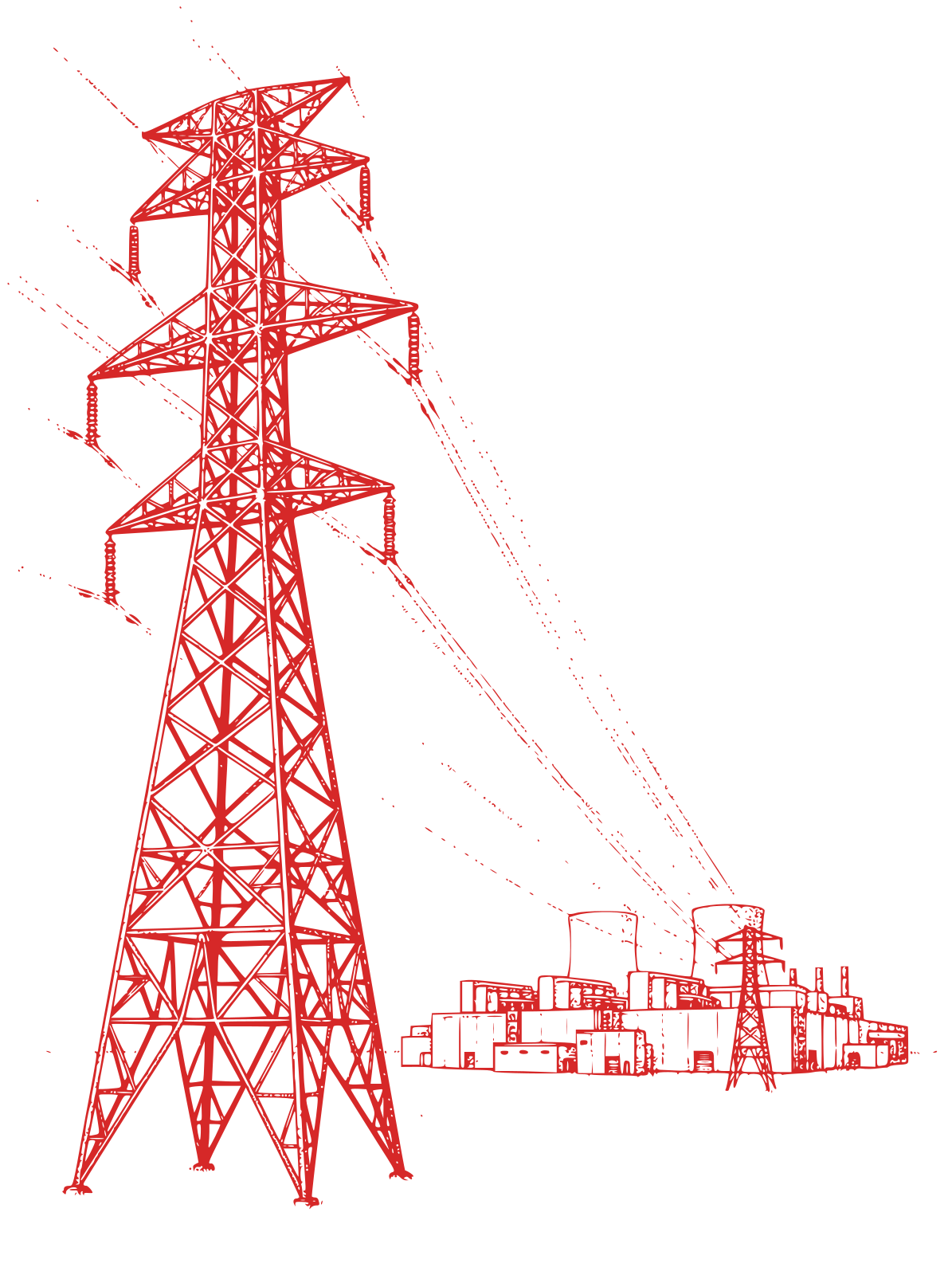
The closest historical analogues are imperfect. Standard Oil at its peak controlled refined petroleum capacity in ways that shaped the geography of American industry. AT&T at its peak controlled telecommunications in ways that shaped the architecture of information flow. Both were eventually subjected to antitrust action. Both were structurally simpler than NVIDIA's current position, because their products were more standardized and the public-interest case for regulation was more easily articulated. NVIDIA's defense — that it is an innovator in a competitive market and that any regulatory intervention would slow the pace of progress — is harder to dismiss than the analogous defenses by Standard Oil or AT&T, because the technological frontier is moving faster and the international competitive pressure is higher.
The frame is doing real political work that the Promethean River's other voices have trouble doing. Huang's sovereign AI thesis is the most successful articulation of why nations should invest in domestic AI infrastructure. The thesis has organized governments across multiple continents around a common technical architecture. The argument has the form of a market argument — every country must own the production of its own intelligence, like every country owns its electricity grid or its food supply — and the conclusion is precisely the conclusion Zheng Yongnian has been arguing for from a different philosophical direction.
This is the convergence that the next part of the book is going to dwell on. Zheng argues for state-led AI from a philosophical position: the civilizational state has a substantive theory of the public good that the market cannot produce. Jensen is selling the infrastructure for state-led AI as a market product. Both believe nations must own the production of their own intelligence. Both end up building the same physical infrastructure. The categories crack open. The Chinese philosophical position and the American market position are producing the same outcome through different rhetorical paths.
What this means in practice is that the physical infrastructure of national AI is becoming a global standard — not because anyone consciously chose it, but because the substrate provider has structured the choice so that no other path is operationally available at scale. The sovereign AI of every country looks like an NVIDIA reference architecture not because the countries chose that architecture from among alternatives but because the alternatives do not exist at the scale required. The choice was a non-choice. The infrastructure is what the substrate provider produces. The substrate provider produces what compounds the substrate provider's position.
What about labor? The question Musk addresses through the lens of work disappearance and Lee addresses through the lens of human beings being for love — what does the substrate provider think about it?

Huang has been remarkably direct about the implications of physical AI for human labor. The progression language → reasoning → agentic → physical AI is not, in his telling, a sequence of capabilities. It is a sequence of compute markets. The fourth wave, physical AI, displaces human labor in domains where the first three waves did not. Driving, warehousing, manufacturing assembly, agricultural work, increasingly construction, eventually elements of personal service — all become candidates for automation under physical AI. The economic logic mirrors the cognitive logic. Wherever the unit economics of automated production fall below the unit economics of human labor, substitution happens. The pace depends on the technology and on regulatory friction. The direction does not.
The substrate provider is positioned to benefit from the substitution regardless of which physical AI applications turn out to dominate. The robotics company that wins the warehouse buys compute from NVIDIA. The autonomous vehicle stack that wins the road buys compute from NVIDIA. The agricultural automation system that wins the farm buys compute from NVIDIA. The substrate provider's position is, again, indifferent to which application companies win. It is the structural beneficiary of the transformation regardless of how the surface plays out.
What the framing does not address is the labor question. Physical AI replaces the manual workforce on a scale comparable to what cognitive AI does for the white-collar workforce. The two displacements together transform employment more sweepingly than any technological transition since the original industrial revolution. The substrate provider is the structural beneficiary of both. The substrate provider is not the steward of either. The asymmetry between economic capture and social responsibility — visible in cognitive AI, becoming sharper as physical AI matures — is the underdiscussed inheritance Huang's thesis leaves to the civilizations that adopt it.

This is the attentional ecology problem from [YOU] on AI translated to the level of the global compute substrate. The substrate is being designed, allocated, and engineered by a single vendor whose incentives are aligned with the maximization of substrate consumption. The question of what the substrate is being used for, who bears the cost of the deployments, how the gains are distributed, what kinds of relational fabric are being eroded — these questions are external to the substrate provider's commercial frame. The substrate provider sells the chips. The questions are someone else's to ask.
Huang has been clearer than most of the Promethean River about the structural position he occupies. He has not pretended to be the steward of the substantive question. He has not claimed that his commercial interests align perfectly with the public interest. He has, in interviews and keynote presentations, been candid about the fact that he is selling picks and shovels and that what the customers do with the picks and shovels is the customers' business. This honesty is itself a contribution. It makes the structural question visible in a way that the other Promethean voices, with their more entangled commercial-and-public-good rhetoric, have made it harder to see.
The substrate is sovereign in a particular sense and not sovereign in another. The substrate has become the de facto global infrastructure of intelligence production. The substrate is owned by a publicly traded corporation in Santa Clara whose discretionary allocation decisions shape the trajectory of every nation's AI program. The substrate is sold under the rhetoric of sovereign capability and produces the reality of dependent infrastructure. The framework is coherent. The framework is also a peculiar geometry that the global political order has not yet figured out how to govern.

[YOU] on AI asks what is worth amplifying. Huang's frame, applied to the same question, answers with admirable directness: I am selling the amplifier. What you choose to amplify is your business. The buyers are the nations. The buyers are the labs. The buyers are the corporations. The substrate is indifferent. The substrate provider sells the substrate at the scale at which the substrate provider can produce it. The substantive question of what the substrate is for is delegated to the buyers. The buyers are too busy buying to ask the substantive question.
This is the most honest position in the Promethean River. It is also the position that most clearly reveals what the river, taken as a whole, has structural difficulty addressing. The river produces astonishing capability. The river concentrates the capability infrastructure in a small number of hands. The river then sells the infrastructure to every actor in the global system, simultaneously, indifferent to which actor wins, indifferent to which substantive answer the actors give to the question of what the infrastructure is for.
The Confucian River would not have produced this geometry. The Confucian River would have insisted on the substantive question. The Confucian River would have refused to delegate the substantive question to the aggregate of buyer decisions. The substantive question, in the Confucian frame, is the question. The substrate is downstream of the question. The substrate that proceeds without the substantive question is the substrate that produces the wisdom-deficient civilization the Confucian River has been warning about for two and a half thousand years.
The next chapter steps back to the bridge inside the Promethean River. After five voices, what does it feel like to take the orange pill inside the river the five of them are swimming in?