The Bridge Before the Rivers Split
We have walked the source springs. We have heard the first two pairings in full philosophical voice — Bing Song against Altman on what abundance is for, Amodei against Yi Zeng on what wisdom requires of architecture. The book's structural geometry is in place.
Before we follow each river separately for the next two parts of the book, we have to stand on the bridge between them and ask what it means that they exist at all, and what it means that we have the orange pill in our hands and can see them both.
The orange pill, in [YOU] on AI, was a metaphor for the cognitive event that makes the fishbowl visible. The recognition is irreversible. You cannot unsee. The frame through which you perceive your work, your tools, your relationships, your obligations has changed, and you do not get to change it back, and you do not get to negotiate with the change. The pill was metaphorical. It happened in the head of the person who took it. The matter did not change. Only the model of the world did.
This book is trying to hand the reader two orange pills, simultaneously. One for each fishbowl. The Confucian River is a fishbowl whose water is 2,500 years old, full of relational ontology and substantive theories of the public good and the conviction that wisdom is more fundamental than intelligence. The Promethean River is a fishbowl whose water is 250 years old (Lockean rights, Cartesian autonomy) or 70 years old (the American mid-century technocratic synthesis) or 15 years old (the contemporary frontier AI lab) depending on where you start counting, full of autonomous-individual ontology and procedural theories of accountability and the conviction that capability is the load-bearing measure.
Both fishbowls are coherent. Both are large. Both have been the water in which great civilizations have produced great work for the lengths of time at which they have been full of the water they are full of. Neither fishbowl is the universal default, although each, from inside, often presents itself that way and is mistaken for that by people who have not yet stood outside it.
The point of taking both pills is not to choose between the fishbowls. The point is not to argue that one fishbowl is right and the other wrong. The point is the binocular vision that comes from holding both fishbowls in your perceptual field simultaneously, refusing to collapse the contradiction, refusing the tempting move of saying that one frame is fundamental and the other is a culturally specific variation.
Both frames are fundamental. To different traditions. With different inheritances. Producing different evaluations. Now meeting, for the first time at this intensity, in the global AI infrastructure that is going to amplify whichever civilizational commitments its developers happen to encode into it.
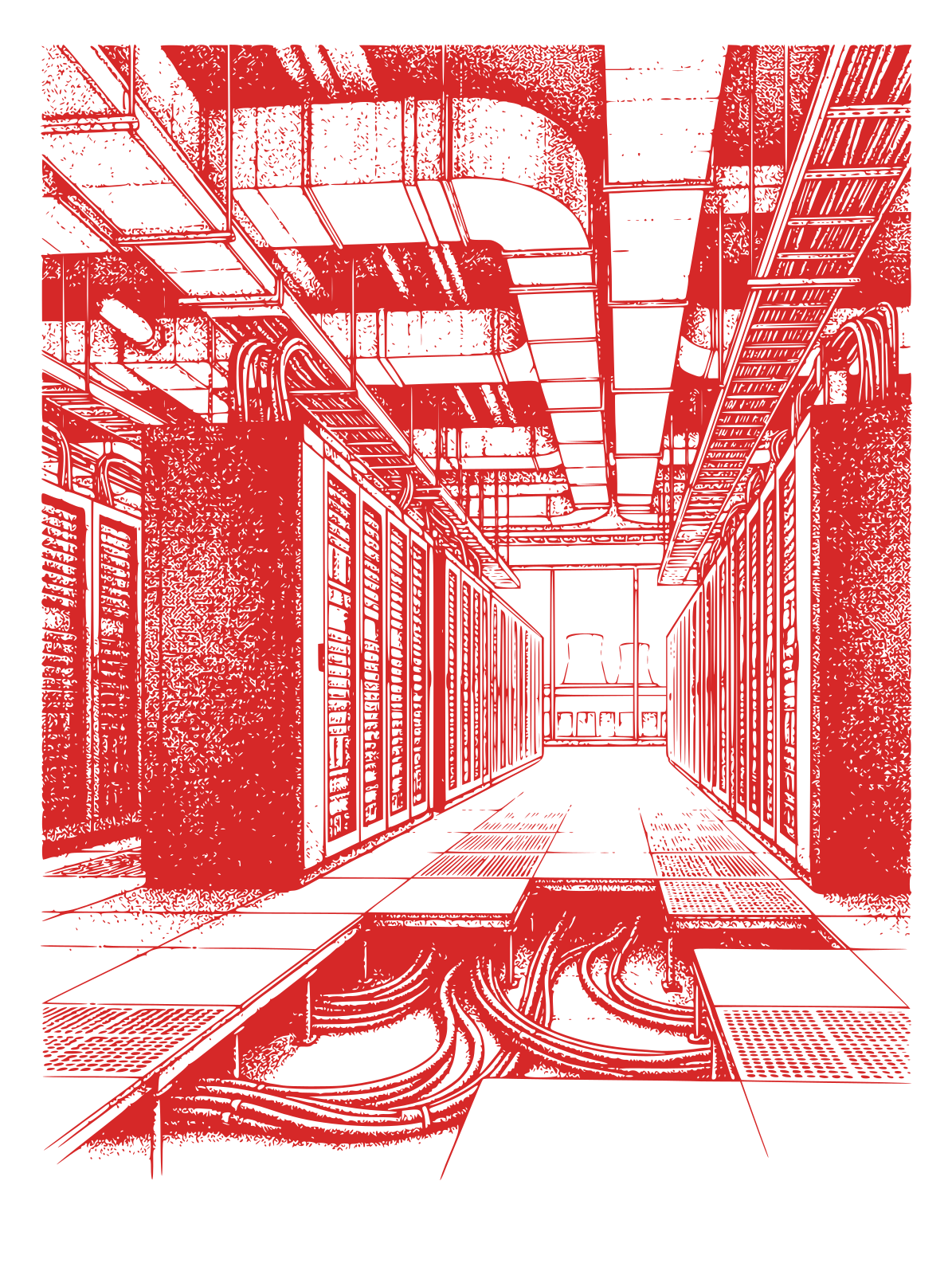
The decisions about what to encode are being made, in 2026, in a small number of rooms. The rooms are mostly in California. Some are in Beijing. A few are in Seattle and Massachusetts and London and Hangzhou. The people in the rooms are mostly working inside one frame — the frame that the room was built inside, the frame that the institutional incentives in the room reward, the frame that the broader cultural environment in which the room sits assumes as the default. The frame is invisible to the people in the room because they are in it.
What this book is trying to do — what the next two parts of the book are going to do in immersive detail — is take the reader through both rooms in sequence. Deep enough in each that the reader feels what the water tastes like. Deep enough in each that the reader cannot pretend that either one is the universal default. Deep enough in each that, by the time the reader reaches Part IV and the head-to-head pairings begin, both fishbowls are visible from outside and the reader can hear, for the first time, the full pitch of the disagreement and the full register of what each side can supply that the other cannot.
The fishbowls are not symmetric. They are not equally well-developed inside the AI conversation. The Promethean fishbowl is dominant in the global discourse for structural reasons that have nothing to do with its substantive merits — the language of the discourse is English, the journals are American, the platforms are American, the venture capital is American, the regulatory frameworks (when they exist) are largely written in vocabulary that the Promethean fishbowl has produced. The Confucian fishbowl is present in the discourse but consistently translated through Western categories, often by translators who do not realize they are translating, sometimes producing concepts that read in English as exotic when in the source tradition they are the natural extension of millennia of careful philosophical work.
This is one reason the book has the structure it does. The Confucian River gets seven full chapters of immersive treatment in Part II — including extracted/analytical chapters on each of the five Chinese thinkers in their own register, plus two Edo bridges that try to articulate what it feels like to take the orange pill inside the Confucian fishbowl. The Promethean River gets the same seven chapters in Part III. Each river deserves the full immersion. The reader cannot meaningfully evaluate the head-to-head pairings in Part IV until both rivers have been walked at length.
The work of the book is not to argue. The work is to make audible. To name what each tradition is in fact saying, in its own register, by its own criteria. To resist the temptation to collapse either tradition into the categories of the other. To let the reader stand on the bridge with both fishbowls visible, both pills swallowed, both vocabularies operative — and to ask the only question that this configuration makes possible to ask.
What is worth amplifying?
That question is the question [YOU] on AI asked at human scale. It is, recursively, the same question this book asks at civilizational scale. The Chinese answer it one way. The Americans answer it another. Both answers are partial. The complete answer requires the conversation the ten thinkers in this book have not yet had with each other, and that the planet cannot afford to delay much longer.
The bridge is built. The pills are taken. The first river is the next stop.
Welcome to the Confucian River. Step in. The water is cold and very old. Some of the currents will be unfamiliar. Stay long enough to feel why they have been flowing in this direction for two and a half thousand years.
Then we will come back to the bank, dry off, and step into the other river. And then, after both, we will meet at the confluence and ask what the future they are flowing toward together is going to look like.
The water is moving. The rooms are filling. The questions are coming due.
Keep climbing.