Yi Zeng — Harmony as Engineering

The Institute of Automation at the Chinese Academy of Sciences sits in the northeastern part of Beijing, in a compound of mid-century buildings that have been modernized but not erased. Yi Zeng's office is in one of those buildings. The window faces a courtyard. Inside, on the bookshelves, the typical artifacts of a senior research scientist: stacks of papers, a few editions of classical Chinese philosophical texts in modern annotated editions, several recent monographs on neuroscience and machine learning, a worn copy of Wang Yangming's Instructions for Practical Living. On the desk, a laptop, two screens, a small jade pendant that someone gave him at a conference in Hangzhou. On the wall, a print of a Tang dynasty painting and, underneath it, a printout of a recent BrainCog architecture diagram with handwritten annotations in red ink.

This is the room from which one of the most ambitious philosophical-engineering projects of the AI era is being conducted. The project's premise is that the Chinese AI ethics framework — built on the relational ontology of Confucianism and the cultivated wisdom traditions of Chinese moral philosophy — can be operationalized as architectural specifications for AI systems. Not retrofitted as policy. Built into the spiking dynamics, the modular structure, the training procedures, the deployment protocols. The project is BrainCog, and Yi Zeng has been building it for a decade.
Begin with the word that has lost meaning in international AI governance documents because it has been used too often without operational content: harmony. Politicians invoke it. Corporate mission statements deploy it. International agreements deploy it as a future state to be desired without specifying what it means. Yi Zeng uses it differently. For Yi Zeng, harmony (he, 和) is not a destination or a feeling. It is a structural property of a system. Like all structural properties, it can be specified, measured, and designed for.

This is not metaphor. It follows directly from the Confucian tradition Yi Zeng inherits, and specifically from the Neo-Confucian synthesis Wang Yangming brought to its most sophisticated form in the fifteenth and sixteenth centuries. In that tradition, harmony is not the absence of conflict. It is the dynamic equilibrium of elements that are genuinely different but mutually constitutive — the way the five flavors in a well-made dish are distinct but produce something together that none produces alone. The concept is irreducibly relational. Harmony cannot be a property of a single element. It can only be a property of a system.

The technical implications are specific. A governance framework oriented toward harmony cannot be satisfied by protecting individual elements — individual users, individual data rights, individual algorithmic outputs — in isolation. It must ask what relationships obtain between those elements, and whether those relationships produce a dynamic equilibrium that benefits the whole. This is structurally different from a governance framework oriented primarily toward preventing harm to individuals, even if the two frameworks sometimes recommend the same actions.
The difference becomes visible in edge cases. When individual benefit and collective harmony conflict — when an AI system produces outcomes that maximize utility for users while degrading some systemic property of the society those users inhabit — a harmony-first framework and a rights-first framework will disagree about what to do. Yi Zeng's framework would in principle authorize constraints on individual-optimizing AI behavior to preserve systemic properties. A framework grounded primarily in individual rights would struggle to justify such constraints without begging the question. This is not the only difference. It is a representative one.
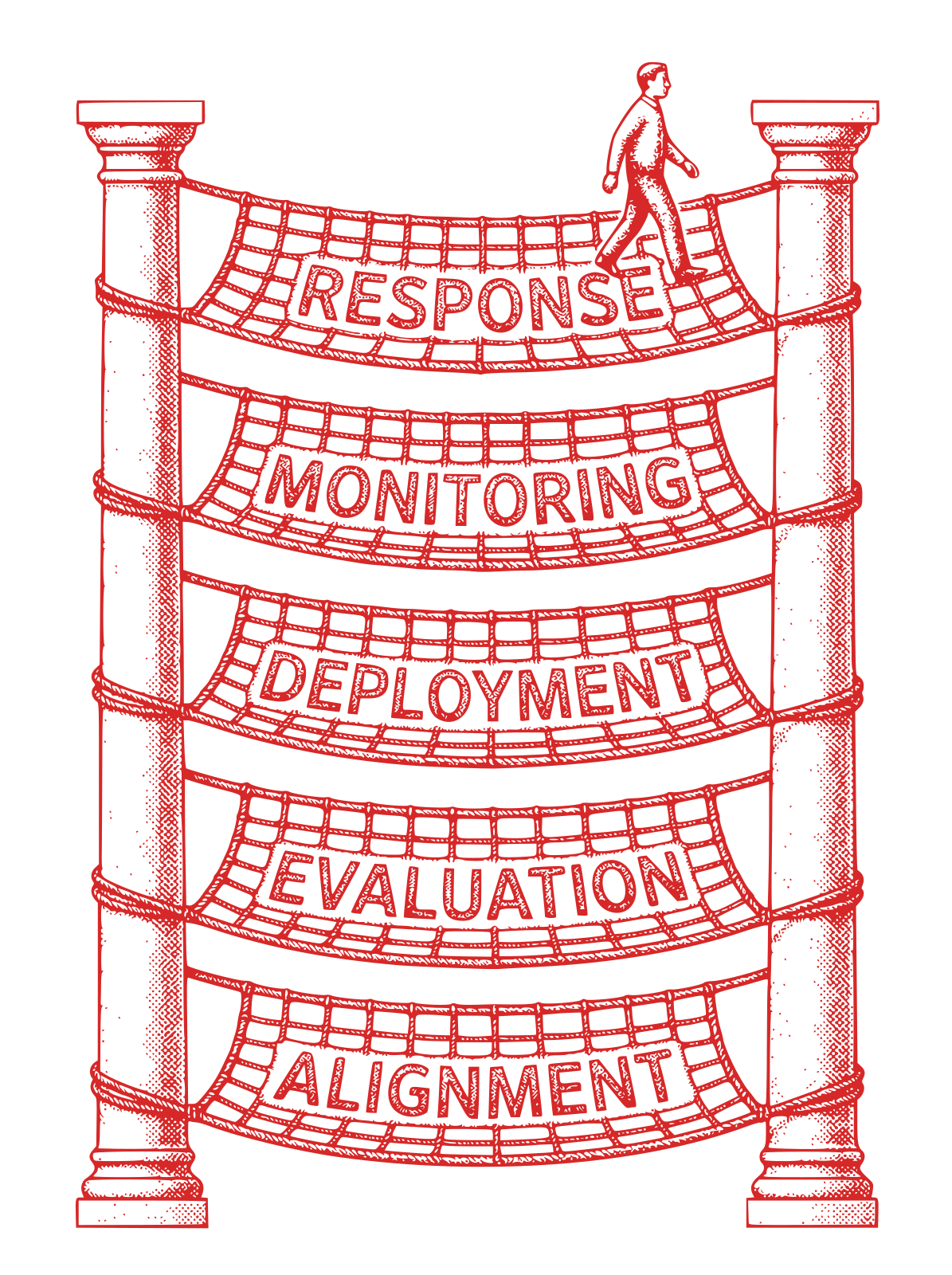
Yi Zeng has not fully worked out the technical specification of harmony as a governance criterion. He would not claim to have done so. What he has done — and the contribution is large — is insist that this is a genuine technical problem, not just a question for philosophers to debate. How do we measure the systemic effects of AI deployment on the relational fabric of a society? is a question that should be on the research agenda. Yi Zeng's BrainCog platform, with its emphasis on modeling the social dimensions of cognition — theory of mind, cooperation, social learning — is partly an attempt to build the computational tools that would make this kind of measurement possible. The platform is incomplete. The platform is also, at present, the most serious attempt anyone in the world is making to build the technical apparatus for harmony-oriented AI evaluation.
Next, the word that has been done less damage to in policy documents but more damage to in casual translation: benevolence. The Confucian concept of ren is usually translated as benevolence, humanity, or humaneness. The English translations are flat. The Chinese concept has texture. In the Neo-Confucian tradition, ren refers to the capacity to feel the suffering of others as one's own — the kind of moral perception that makes ethical action not a calculation but a response. Mencius argued the capacity is native to humans: the person who sees a child about to fall into a well feels alarm and compassion immediately, before any calculation of self-interest. The challenge of moral cultivation is not to implant ren from outside but to nurture and develop what is already present.
Yi Zeng's argument is that ren should be treated as an engineering constraint in AI system design, not as a value that might be added later through ethical review. This sounds like a slogan. It is actually a precise technical claim.

An engineering constraint is a requirement that a system must satisfy at the design stage, not a property that can be retrofitted onto a working system. Safety is an engineering constraint for bridges. Sterility is an engineering constraint for surgical instruments. These are not add-ons. They are built into the materials, the architecture, and the testing procedures from the beginning. The cost of retrofitting is prohibitive. The consequences of failure are severe.

Yi Zeng's argument is that benevolence — the capacity to respond appropriately to the suffering and flourishing of other agents — is an engineering constraint for AI systems in exactly this sense. You cannot build a system capable of harming people at scale, deploy it, and then add benevolence through fine-tuning or guardrails. The harm is already done. The architecture that enabled the harm is in place. What you get by retrofitting is a system that can discuss benevolence, not a system that has it.
The technical challenge of building ren into an architecture is immense. Yi Zeng's answer involves several components. The system must have a genuine model of other agents — not a statistical approximation of what people say, but an architecture capable of representing other agents as having states, interests, and perspectives that matter. The system must be capable of detecting when its actions cause harm, in a way that is integrated into its decision-making rather than applied as a post-hoc filter. And the system must have something like the alarm response Mencius described — an immediate, architecturally embedded sensitivity to situations that call for care.
BrainCog's work on theory of mind and social cognition is an attempt to build the first component. The system's spiking neural networks include modules for modeling other agents' intentions and states — modules inspired by the mirror neuron systems neuroscience has identified as central to social cognition in primates. Whether these modules produce anything like genuine ren is uncertain. What Yi Zeng claims is that they are moving toward the right architecture. The architecture of current LLMs — statistical prediction of tokens — is moving in the wrong direction.

This argument has a significant governance implication. Most current AI regulation focuses on the outputs of AI systems: what a system says, what decisions it makes, what harms it produces. A ren-based engineering approach would focus instead on the architecture that produces those outputs: does the system have the structural capacity for genuine responsiveness to the states of others? Output-focused regulation can constrain harmful outputs without addressing the underlying architecture. Architecture-focused governance would require intervening at the design stage, before any system is deployed.
The two governance approaches have different implications for what frontier AI development should look like. Yi Zeng's approach is more demanding. It is also, on his account, the only approach that can actually produce systems whose alignment with human flourishing is structural rather than performative.
This brings us to the deepest claim in Yi Zeng's framework, the one that ties harmony and ren together and connects them to the wisdom gap that runs through his work. Current AI systems are capable without being wise. They can perform impressively on a wide range of tasks. They cannot perceive what a situation genuinely calls for in the way wisdom requires. This is not a failure of scale — more parameters will not produce wisdom. It is an architectural failure: current AI systems lack the self-modeling, the embodied temporal awareness, and the genuine social cognition that wisdom seems to require.
The practical implications are not theoretical. An AI system without wisdom deployed in high-stakes contexts — medical diagnosis, legal decision-making, governance advice — will make errors a wise human would not make, because those errors are not failures of capability. They are failures of perception. They are failures to recognize what the situation calls for. The errors will often be invisible to standard capability evaluations, because capability evaluations test for correct outputs given specified inputs, and the wisdom failure is precisely the failure to recognize when the specification is wrong.
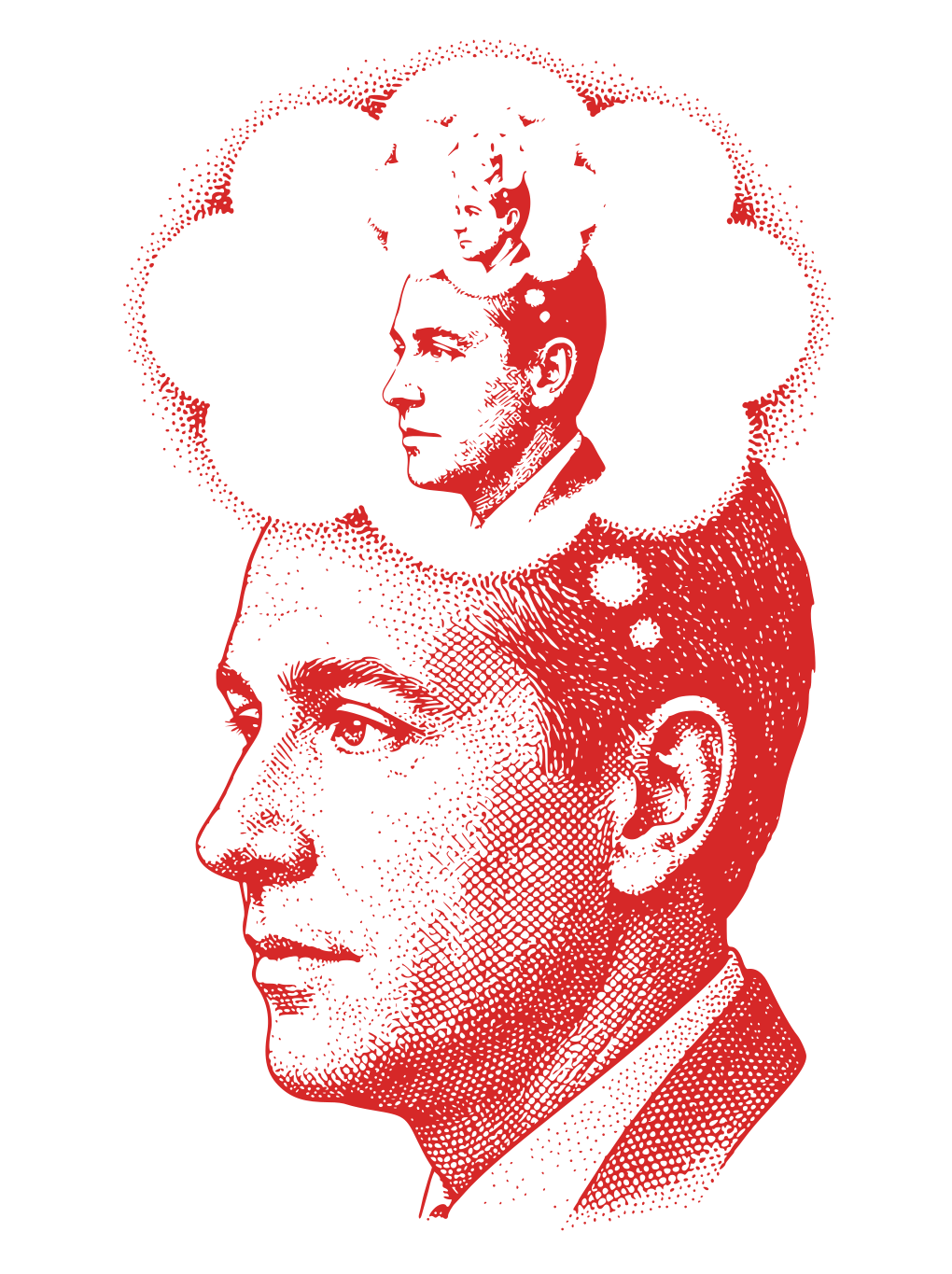
This connects directly to [YOU] on AI's central argument about what AI is actually doing when it appears to be reasoning. The appearance of reasoning, in a system without wisdom, is a performance of the pattern of reasoning rather than reasoning itself. Yi Zeng extends the point: the appearance of ethical judgment, in a system without genuine moral perception, is a performance of the pattern of ethical judgment. Governance frameworks that evaluate AI systems by whether they appear to behave ethically are not adequate substitutes for governance frameworks that evaluate whether AI systems have the architectural properties that make genuine ethical judgment possible.
Yi Zeng's vision is for harmonious symbiosis between humans and AI. The metaphor is biological. A genuine symbiotic relationship requires that both parties contribute something the other cannot provide independently, that the relationship is stable over time, and that the relationship produces emergent properties neither party has in isolation. The famous example is the mycorrhizal network in which fungi and plant roots exchange nutrients in ways that benefit both and enable the forest ecosystem that depends on them.
Applied to human-AI relationships, the metaphor implies several things. The relationship must be genuinely bidirectional. Humans must contribute something AI cannot provide (moral perception, contextual wisdom, embodied experience). AI must contribute something humans cannot provide (scale, speed, pattern recognition across vast datasets). The relationship must be designed for stability. Governance frameworks must prevent either party from extracting so much from the other that the relationship becomes exploitative or parasitic. The relationship will produce something new — a form of collective intelligence that is neither human nor AI alone.
Critics from both Western liberal and techno-utopian directions have challenged the symbiosis frame. Liberal critics worry that "harmony" and "symbiosis" in the Chinese governance context are code for arrangements in which collective requirements suppress individual dissent. Techno-utopians worry that the emphasis on human-AI balance constrains the development of AI systems that might, if allowed to develop freely, produce outcomes far better than any balanced symbiosis would achieve.

Yi Zeng's response to both critiques is similar: the alternatives have costs that their proponents are not acknowledging. Unconstrained AI development optimizing for individual user engagement produces systemic harms to the communities those users inhabit. Unconstrained AI development optimizing for capability produces systems without the wisdom to deploy those capabilities well. The symbiosis framework is not a constraint on flourishing. It is a specification of what flourishing for both humans and AI actually requires.
Whether the vision is achievable is uncertain. The institutional arrangements, the governance tools, and the technical architectures genuine human-AI symbiosis would require do not yet exist. Yi Zeng is under no illusion they are close at hand. But he argues — and this is perhaps his most important contribution — that the absence of a clear vision of where we are going is itself a governance failure. If we do not know what a good human-AI relationship looks like, we cannot evaluate whether current AI development is moving toward it or away from it. The symbiosis metaphor is his attempt to provide that vision, with enough precision to be useful without pretending to a certainty the situation does not warrant.
Yi Zeng's framework, taken as a whole, places three demands on the global AI conversation that the conversation has not yet figured out how to receive. First: that harmony is a structural property that can be specified and engineered, and that AI systems must be evaluated by their effects on relational systems, not only by their effects on individual users. Second: that benevolence must be in the architecture from the beginning, and that retrofitted ethics is not a substitute. Third: that wisdom is more fundamental than intelligence, and that a civilization deploying powerful AI without sufficient wisdom is at structural risk in ways the procedural governance apparatus cannot remedy.

These demands are not unreasonable. They are also not, currently, on the agenda of most frontier AI labs in California or Beijing. The room where Yi Zeng is working is, at present, smaller and less well-resourced than the rooms where the largest models are being trained. The Chinese AI ecosystem, like the American, is split between actors taking Yi Zeng's framework seriously and actors building as fast as they can without regard to it.
Whether Yi Zeng's framework prevails as the basis of Chinese AI development — and whether anything analogous prevails as the basis of American AI development — is the open question on which a substantial fraction of the next decade depends. The framework is not a panacea. It is, however, the most sustained attempt anyone is currently making to engineer the Confucian inheritance into the contemporary AI substrate. That attempt deserves international attention it has not, to date, received.
The orange pill, in [YOU] on AI, makes the fishbowl visible. Yi Zeng's framework — by insisting that the technical apparatus of AI must be evaluated by substantive criteria drawn from a relational philosophical tradition — is one of the most precise tools available for making the Western fishbowl visible from outside. Whether the West can receive that visibility is the question on which the bridge in Part V of this book will turn.
For now, the next stop is the chapter on Bing Song, who is doing similar work at the philosophical level that Yi Zeng is doing at the architectural one.