Zheng Yongnian — The Civilizational State and Its AI

Zheng Yongnian is, in the strict sense, the political scientist of the Chinese AI conversation. He works at the intersection of comparative political theory, Chinese institutional history, and contemporary technology policy. He is professor at the Chinese University of Hong Kong's Shenzhen campus and has authored a long list of monographs on the Chinese state, the international order, and the political economy of contemporary China. In the AI conversation, his role is to make a specific claim that has not yet been adequately absorbed in the Anglophone discourse: the Chinese state is not best understood as a strong version of a familiar liberal-democratic type. It is a different type of institution entirely, with a different theory of legitimacy, a different time horizon, and a different relationship to transformative technology.
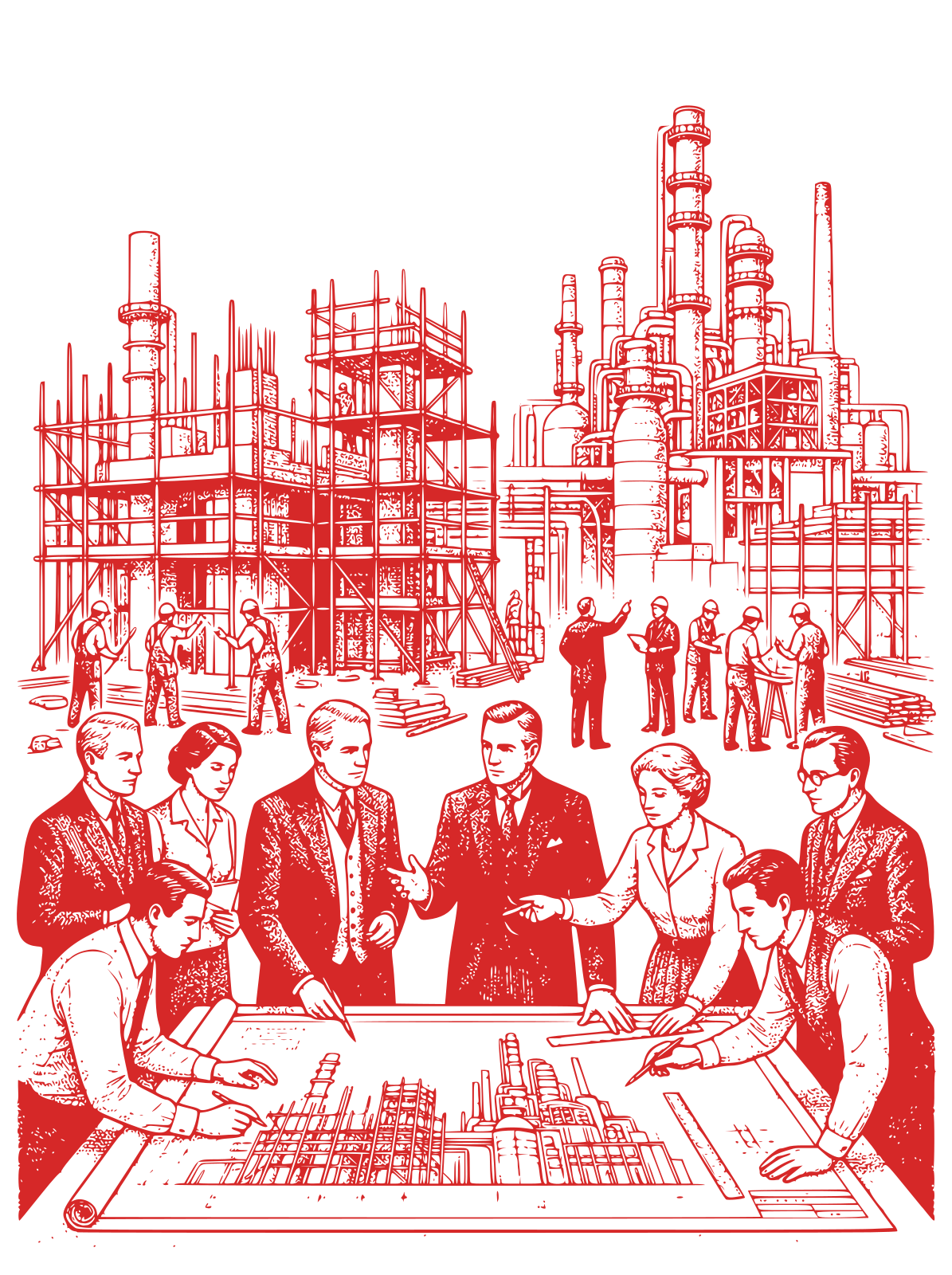
The starting point is the concept Zheng has developed across multiple books: the civilizational state. A civilizational state is not merely a large or powerful state. It is a state that has internalized, over centuries of institutional development, a conception of governance as the maintenance of civilizational order. The Chinese state does not merely administer a territory. It embodies a civilizational project — the continuation and refinement of a form of social organization that traces its lineage through dynasties, revolutions, and reinventions across more than two thousand years.
This has specific institutional consequences. The Chinese state's claim to legitimacy is not based primarily on electoral mandate. It is based on performance — on the capacity to deliver stability, prosperity, and what might be translated as "good governance" in the Confucian sense: governance that maintains the conditions for human flourishing within the civilizational framework. When the Chinese Communist Party describes its role as serving the people, it is invoking a legitimation logic that is structurally continuous with the imperial tradition, in which the ruler's claim to power depended on demonstrating the competence and moral quality the Mandate of Heaven required.

This framing matters for AI governance. A state that understands its legitimacy in performance terms has a different relationship to transformative technology than a state that understands its legitimacy in procedural terms. The liberal-democratic state can govern AI through procedure: write the rules, ensure they are applied fairly, protect individual rights. If the procedure is followed, the governance is legitimate regardless of the outcome. The civilizational state cannot make this move. Its legitimacy depends on outcome — on whether the technology actually serves the people, actually maintains social order, actually preserves the conditions for civilizational continuity.
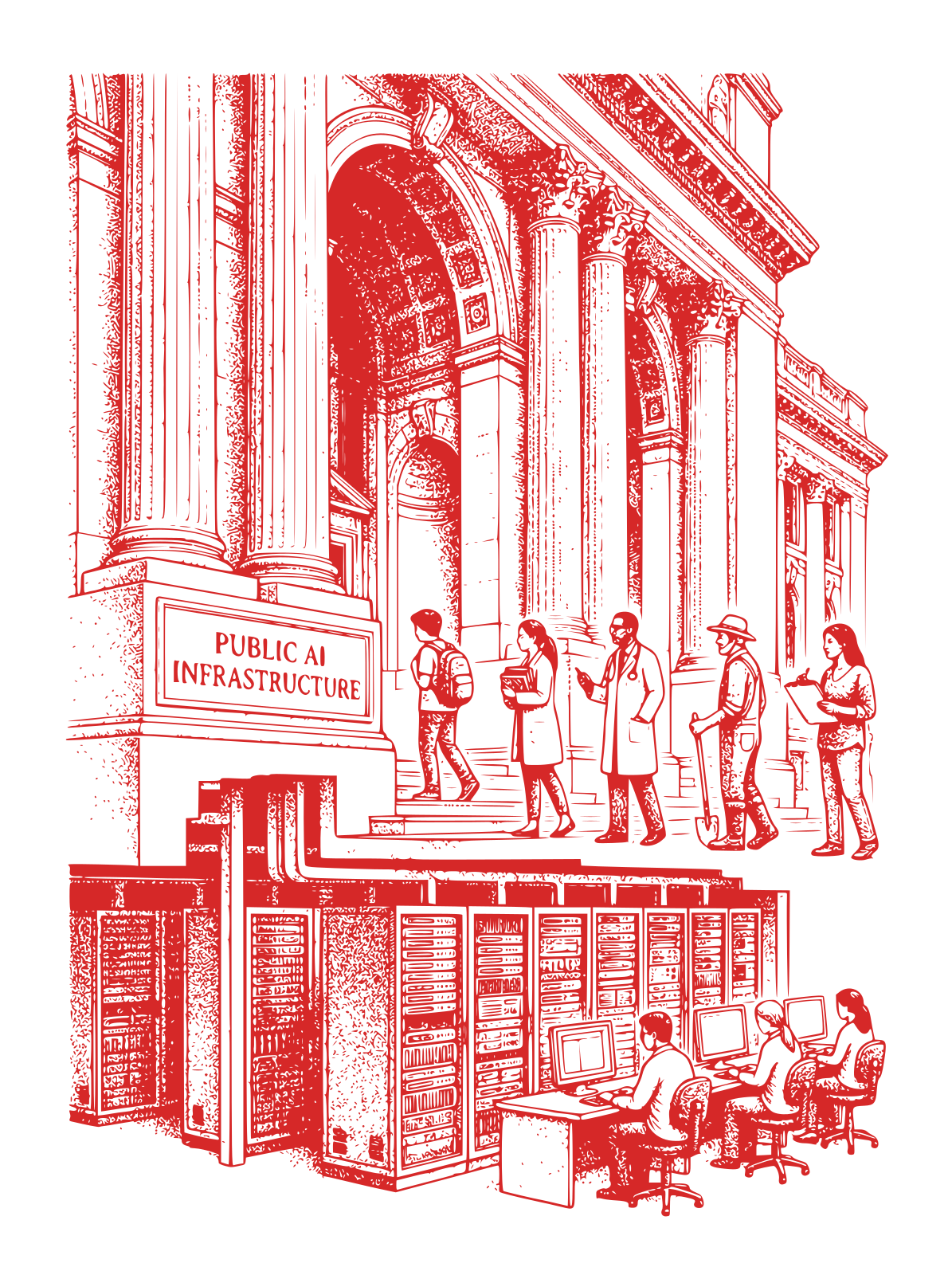
This explains what Western observers often misread as Chinese AI governance being simultaneously more interventionist and more outcome-oriented than Western approaches. It is not more interventionist because the Chinese government is uniquely controlling. It is more interventionist because the legitimation logic of the Chinese state requires intervention. If AI produces outcomes that damage social order, the state that fails to intervene loses the basis of its claim to govern.
Zheng's historical analysis traces this through multiple episodes of Chinese state engagement with transformative technology. The hydraulic engineering projects of the ancient state, the management of printing technology in the imperial period, the state's role in industrialization — all exhibit the same pattern. The Chinese state does not merely regulate technology as an external force. It incorporates technology into the project of governance. Technology and state co-evolve, each shaping the other in ways that produce forms of governance that cannot be derived from either the technology's technical characteristics or the state's pre-technological institutional logic.

The implications for the current AI moment are considerable. When the Chinese state deploys AI in governance functions — social credit systems, digital monitoring of public space, algorithmic management of public services — Western commentators typically analyze these deployments through the lens of surveillance and control: is this consistent with human rights, is this an expansion of authoritarian power, is this evidence that China is building a digital dystopia?

Zheng's framework redirects the analysis. The question is not whether these deployments are consistent with liberal-democratic norms. They are not, by design, because they emerge from a different normative framework. The question is whether they serve the legitimation purpose of the civilizational state. Are they maintaining social order? Are they improving the capacity to deliver governance outcomes the Chinese conception of the good identifies as important? Are they, in short, working — not by Western standards, but by the standards internal to the project they are part of?
This is not a defense of any specific application. Zheng is entirely aware that the technologies being deployed in China's digital governance system raise serious questions — about proportionality, about accountability, about the concentration of power in the hands of entities that lack effective mechanisms for popular contestation. But he insists these questions must be asked from within the civilizational framework being governed, not imposed from outside it.
The concept of the public good in the Confucian tradition has a specific shape that the Anglophone AI discourse has had trouble translating. The Western liberal account of the public good is aggregative and procedural. The public good is what results from the correct aggregation of individual preferences — through markets, through democratic deliberation, through the operation of legitimate institutions. It is not something that can be specified in advance, because the whole point of liberal governance is to create the conditions under which individuals can pursue their own conceptions of the good rather than having a conception imposed on them.
The Confucian account is substantive and relational. The public good is not the aggregation of individual preferences. It is the maintenance of the conditions for social harmony — the forms of relation between persons, between families, between communities and the state, that constitute the fabric of a civilization. These conditions can be specified, at least in outline. Good governance promotes filial piety, social obligation, the kind of human relation in which persons are mutually constituted rather than merely mutually tolerated. Bad governance destroys these conditions.

The implications for AI governance are significant. If the public good is aggregative, then the governance question for AI is whether it is maximizing the satisfaction of individual preferences in a fair and efficient way. If the public good is relational, then the governance question is whether AI is maintaining or damaging the forms of social relation that constitute the civilization's fabric.
These questions have different answers in practice. Consider social media algorithms optimized for engagement. By the aggregative account, they are good if they are satisfying user preferences — people engage with content they find compelling, and the algorithm delivers it. By the relational account, they are bad if they damage the forms of social relation that constitute the civilization — if they promote outrage over empathy, if they reinforce social division, if they replace the friction-rich engagement of face-to-face community with frictionless digital consumption.
Zheng's analysis of what he calls "artificial ignorance" — the intellectual deterioration that results from excessive reliance on AI tools — is grounded in the relational account of the public good. His concern is not primarily that individuals are making choices that are bad for themselves (the Western paternalism framing). His concern is that a technology that substitutes for human intellectual activity is damaging the capacity for the kind of engaged, effortful thinking that social relations require. A society in which people do not think — in which the cognitive work of understanding the world is outsourced to AI systems — is not merely a society of diminished individuals. It is a society in which the relational fabric has been damaged, because genuine social relation requires the kind of cognitive engagement AI is making optional.
This connects directly to [YOU] on AI's wisdom gap — the widening distance between accelerating technological power and the slower-moving capacity of human institutions, including individual humans, to develop the wisdom required to deploy that power. Zheng's contribution is to extend the framework from the individual to the civilizational level. The wisdom gap is not just a question of individual cultivation. It is a question of whether the civilization deploying the technology is maintaining the institutions, practices, and relational conditions through which collective wisdom is possible.

Now the geopolitical implication, which is the part of Zheng's framework that the global AI conversation most urgently needs.
The geopolitical dimension of AI governance has become impossible to ignore. The United States and China are competing for technological leadership in AI in ways that are shaping research priorities, investment flows, talent competition, and governance frameworks across the entire global system. This competition is often analyzed as a race — a zero-sum contest in which one party's gain is the other's loss, and the winner will establish the standards the rest of the world is forced to adopt.
Zheng's analysis resists the race framing. His writing on Sino-American AI relations returns to a specific observation: the competition is not symmetric. The United States and China have different AI capabilities, different AI governance challenges, and different institutional structures for addressing those challenges. A competition between asymmetric actors is not best modeled as a race where both runners are trying to reach the same finish line.
Zheng's characterization is illuminating. American AI development resembles a powerful engine without adequate brakes: prodigious capabilities at the frontier, ambitious in innovation, weak in governance mechanisms that can address the social consequences of rapid deployment. Chinese AI development resembles an engine with brakes but insufficient horsepower: strong in regulatory capacity, oriented toward social order, but constrained in the frontier capabilities that determine where the technology goes.
The mechanical metaphor identifies complementary rather than competing strengths. A vehicle needs both an engine and brakes. A global AI development system — if it were possible to think of it as a coherent system rather than a collection of competing national projects — would need both the innovative capacity American AI development demonstrates and the governance capacity Chinese AI regulatory infrastructure has developed.

But the world is not a coherent system. It is a multipolar order in formation, in which different civilizational traditions are developing different AI capabilities and different AI governance approaches, and in which the question of whose approach prevails will be determined by power, persuasion, and the performance of different models in the real world. Zheng's analysis situates this multipolar reality within his civilizational framework: the different approaches are not merely different policy choices. They are expressions of different civilizational traditions with different understandings of what AI is for.
The implications for global AI governance are significant. The current governance discourse is dominated by institutions and frameworks that reflect Western values and interests — the OECD AI Principles, the EU AI Act, the various frameworks American technology companies have developed for responsible AI. These frameworks are being offered as global standards. The expectation is that other countries will adopt them, because they represent the best thinking about AI governance, and because the countries that develop the most advanced AI systems will have the power to enforce their governance frameworks as de facto global standards.
Zheng does not dispute the power dimension. He observes, accurately, that governance standards follow technological leadership, and that countries that lead in AI capability will have disproportionate influence over global AI governance. But he challenges the normative framing — the claim that Western governance frameworks are not merely more powerful but more legitimate, better adapted to the governance task, more adequate to the civilizational challenges AI poses.
His challenge rests on the civilizational analysis. The Western frameworks are adequate to Western civilizational contexts. They are not adequate to Confucian, Islamic, or Indian civilizational contexts, because they were not designed with those contexts in mind and are not calibrated to the governance challenges those contexts pose. A multipolar AI governance order — one that is adequate to a multipolar world — must include frameworks adequate to multiple civilizational traditions.
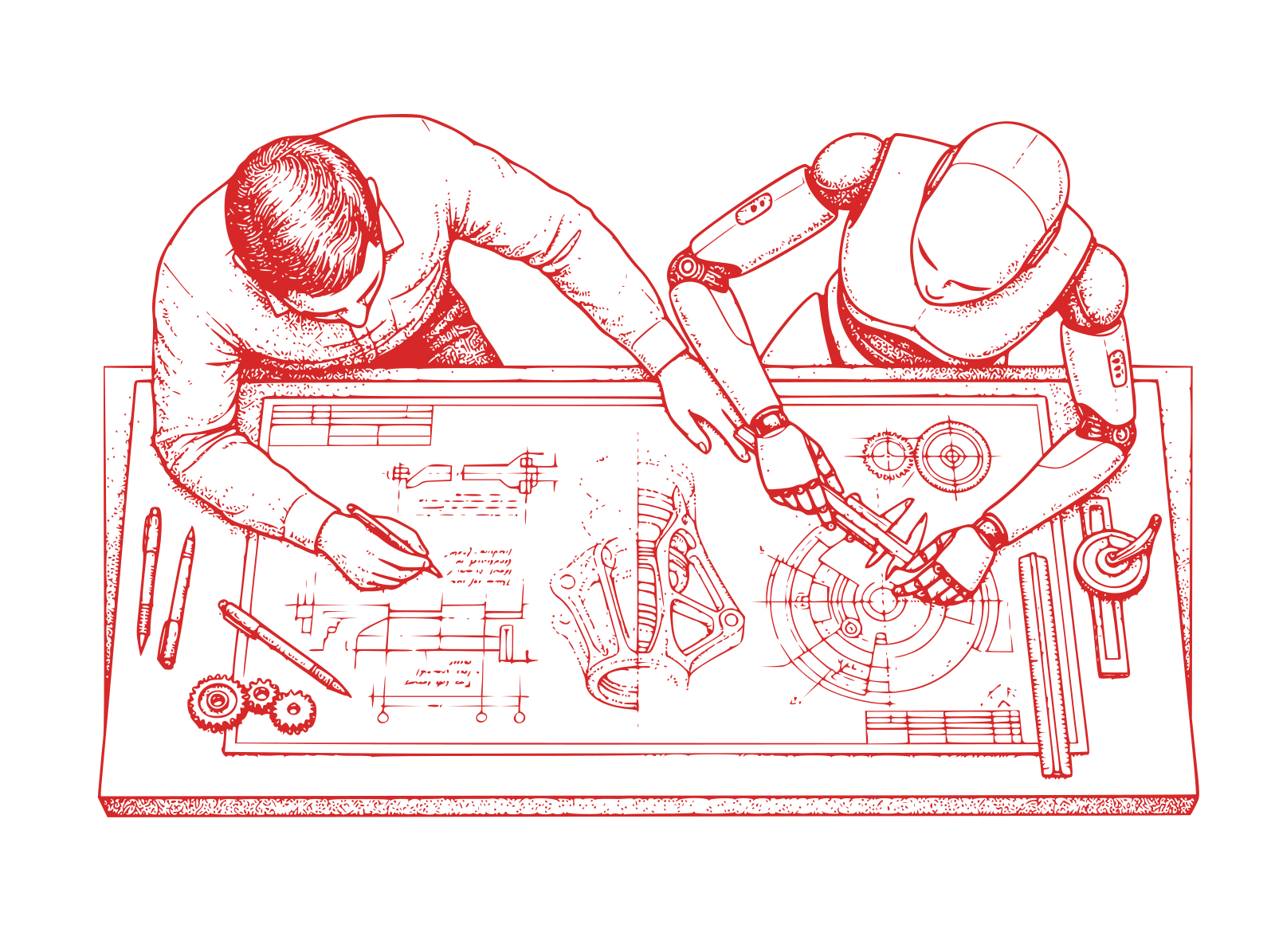
This is not a call for governance relativism — for the position that any governance approach is as good as any other. It is a call for governance pluralism — for the recognition that different civilizational contexts require different governance frameworks, and that global governance of AI must be built through dialogue between those frameworks rather than through the imposition of one civilizational tradition's self-understanding on all others.
Zheng's framework, taken together with Yi Zeng's and Bing Song's, constitutes the most articulate Chinese contribution to the global AI conversation. None of these thinkers speak for the Chinese state. None of them speak for all of Chinese AI. None of them claim to. What they offer is a philosophical and political-theoretical resource that the global conversation has not yet fully absorbed. The resource is available. Whether the conversation is willing to receive it is a question on which the bridge in Part V will depend.
The orange pill makes the fishbowl visible. Zheng's civilizational state framework makes visible the fishbowl in which Western political theory has been conducted — the assumption that the procedural liberal-democratic state is the universal default and that other forms of state are deviations from or deficiencies relative to it. Zheng's claim is that this assumption is itself a civilizational artifact, and that the Chinese tradition has produced a different and equally serious answer to the question of what governance is for. Whether the West can stand outside its own assumptions long enough to receive that answer is the question on which the multipolar AI world is going to turn.